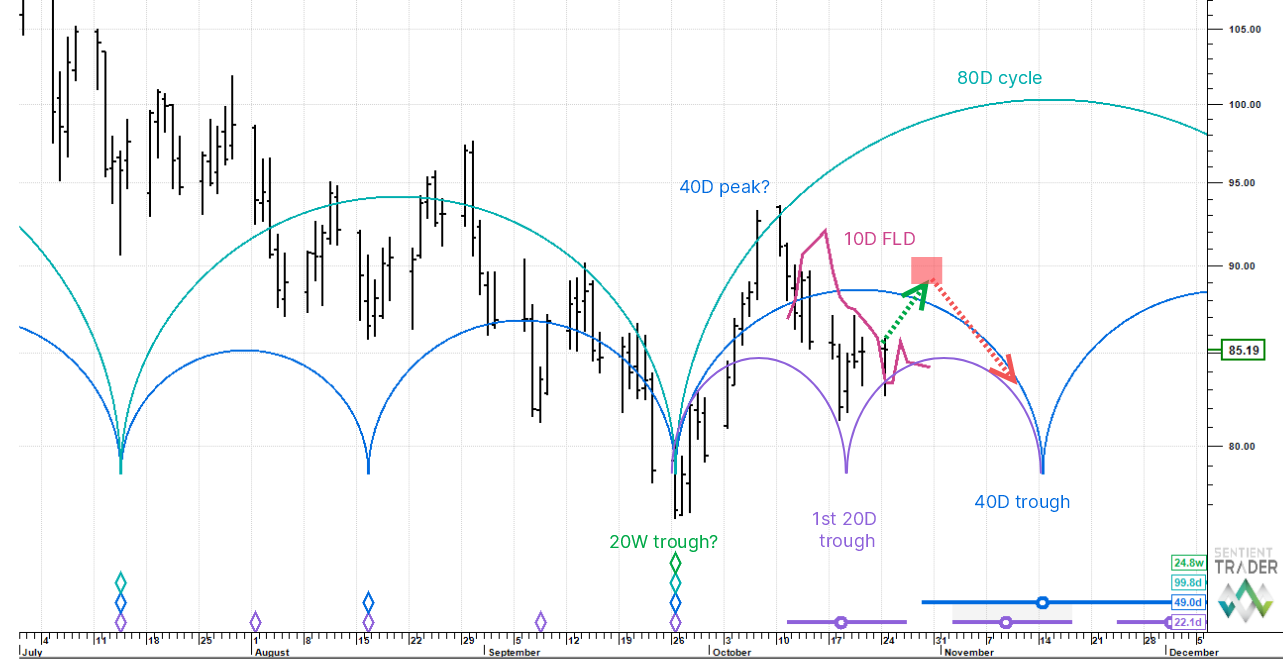
The Brent crude benchmark is currently undergoing a structural price re-rating that threatens to eclipse all historical monthly records. This is not a standard rally fueled by sentiment; it is a calculated convergence of multi-year underinvestment, geopolitical supply shocks, and the inelasticity of post-industrial energy demand. When Brent approaches its largest monthly gain on record, the underlying math suggests a fundamental breakdown in the global supply buffer rather than a temporary spike in trading volume.
The Tripartite Architecture of the Current Price Surge
The rapid appreciation of Brent crude is sustained by three distinct, reinforcing pillars that prevent the market from reaching a new equilibrium in the short term.
Supply Side Inelasticity and the Spare Capacity Myth
The global energy market operates on a razor-thin margin of spare capacity. Decades of "green-shifting" capital allocation have starved traditional upstream exploration of necessary funding. This creates a hard ceiling on how quickly production can be ramped up to meet unexpected demand. When a major producer is sidelined by sanctions or operational failure, the "buffer" is nonexistent.The Geopolitical Risk Premium as a Baseline
Conflict in energy-rich regions no longer adds a temporary premium; it shifts the floor of the entire price curve. The current monthly record is largely a function of the market pricing in a permanent or semi-permanent loss of millions of barrels per day. This is not a "spike" that will revert to the mean; the mean itself has moved.Demand Persistence in the Face of Monetary Tightening
The traditional correlation between rising interest rates and cooling oil demand is breaking. While central banks attempt to dampen inflation by raising the cost of capital, the physical necessity of oil for transport and petrochemicals remains relatively price-inelastic. People and goods must move, regardless of the Federal Reserve’s overnight rate.💡 You might also like: Buffett is Not Retiring He is Arbitraging the Death of Objective Truth
Mapping the Flow of Barrels
To understand why this monthly record is being shattered, one must examine the physical displacement of crude. The oil market is a complex web of logistics. When a primary supply route is blocked or a specific grade of crude (like Urals or Brent) becomes politically toxic or physically unavailable, the resulting scramble for "homeless" barrels creates a localized bidding war.
This bidding war is most visible in the "dated Brent" market—the price of physical cargoes set for specific delivery dates. When the physical price deviates significantly from the futures price, it signals a desperate need for immediate delivery. This phenomenon, known as backwardation, is currently at extreme levels, indicating that traders are willing to pay a massive premium for oil today versus oil three months from now.
The Cost Function of Global Energy Refinement
Oil prices do not exist in a vacuum. The price of Brent is a lead indicator for the entire refined product suite, specifically diesel and jet fuel. The current monthly surge creates a feedback loop in the refining sector.
- Crack Spreads: The margin between a barrel of crude and the products refined from it. High Brent prices usually squeeze these margins unless product demand is high enough to pass the costs to the consumer.
- Refinery Utilization: Most global refineries are operating at near-maximum capacity. Any further increase in Brent prices cannot be easily offset by increasing the supply of refined products, leading to a "double squeeze" on the end-user.
- Inventory Depletion: Global strategic reserves are at multi-decade lows. The ability of governments to dampen price volatility by releasing stored crude is effectively exhausted, removing the last psychological barrier for speculative bulls.
The Failure of Traditional Valuation Models
Standard econometric models often fail during periods of extreme price compression because they assume linear relationships. The current Brent rally is non-linear. It is driven by "threshold effects"—points at which a marginal decrease in supply leads to a disproportionate increase in price because the alternative is a total cessation of economic activity.
The logic of the current market is dictated by the "marginal barrel." If the world needs 100 million barrels a day and only 99 million are available, the price for that 100th barrel isn't just 1% higher; it is whatever the most desperate buyer is willing to pay to keep their economy functioning. This "scarcity rent" is what is currently being captured in the monthly price data.
Structural Bottlenecks in the Brent Complex
The Brent benchmark itself is a composite of several North Sea crudes (BFOET: Brent, Forties, Oseberg, Ekofisk, and Troll). The declining production in these fields means the benchmark is increasingly sensitive to small disruptions. When the volume of physical oil underlying the world's most important price marker shrinks, volatility naturally increases. We are seeing the result of a "thin" market being hit by a "thick" demand wave.
This creates a scenario where financial players—hedge funds and commodity trading advisors (CTAs)—exacerbate the move. As the price breaks through technical resistance levels, automated selling and buying programs trigger, adding momentum to a move that was originally started by physical shortages.
Limitations of Current Strategic Reserves
The release of Strategic Petroleum Reserves (SPR) by various nations has historically been the primary tool for price stabilization. However, the efficacy of this tool is now compromised by two factors:
- Refining Mismatch: The crude held in reserve often does not match the technical requirements of the refineries that need it most.
- Market Anticipation: The market knows these reserves are finite. Every barrel released today is a barrel that must be repurchased later, creating a "floor" for future prices that traders are already beginning to price in.
The Strategic Displacement of Energy Capital
As Brent sets its sight on record monthly gains, the long-term implication is a permanent shift in how capital is deployed in the energy sector. The current high-price environment acts as a massive tax on consuming nations, transferring wealth to producing nations at a rate not seen since the 1970s. This capital transfer is being used not for new drilling, but for sovereign wealth diversification and debt reduction by major producers, further ensuring that supply remains constrained.
The risk for the global economy is a "volatility trap." High prices lead to political instability, which leads to further supply disruptions, which leads to higher prices. This cycle is currently being played out in the Brent market, and the record monthly gain is merely the numerical representation of this deepening systemic instability.
Structural Realignment of the Energy Floor
The primary strategic move for industrial consumers and sovereign entities is the immediate transition from "just-in-time" energy procurement to "just-in-case" inventory building. The record-breaking ascent of Brent signifies that the era of cheap, reliable energy buffers has ended. Strategic positioning now requires:
- Contractual Hardening: Moving away from spot-market exposure toward long-term, fixed-price or capped-supply agreements, even at current elevated levels, to hedge against the risk of total physical unavailability.
- Infrastructure Adaptation: Refineries must be retrofitted to handle a wider variety of crude grades to bypass the bottlenecks currently strangling the Brent complex.
- Demand Destruction Integration: Heavy industries must prepare for "peak price" windows where operations are systematically throttled to avoid consuming energy at negative-margin price points.
The record gains in Brent crude are not an anomaly; they are the market's way of signaling that the current global energy architecture is no longer fit for purpose. The price will continue to find new highs until either the supply-side underinvestment is reversed—a process that takes years—or the demand side is forcibly reduced through economic contraction.