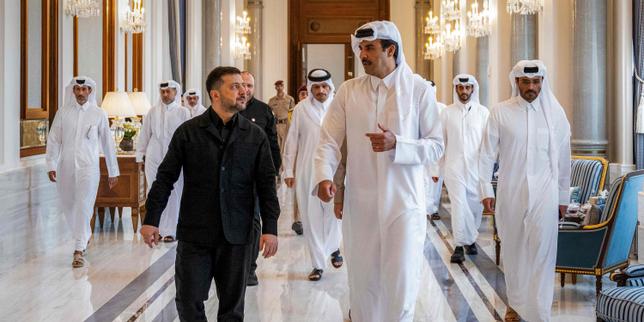
Volodymyr Zelensky’s recent diplomatic tour across the Gulf states—specifically the United Arab Emirates, Qatar, and Saudi Arabia—represents a shift from humanitarian appeals to a sophisticated model of long-term industrial integration. While media coverage often focuses on the "historic" nature of the contracts signed, a rigorous analysis reveals a two-pronged strategy: securing immediate defense-industrial liquidity and embedding Ukraine into the post-oil economic diversification plans of the Gulf Cooperation Council (GCC).
The Architecture of the Reconstruction-Investment Loop
The diplomatic framework operates on a principle of reciprocal necessity. Ukraine requires immediate capital to sustain its domestic industrial base, while Gulf nations seek to hedge against global food insecurity and acquire battle-tested defense intellectual property. This interaction creates three distinct vectors of cooperation:
- Agro-Industrial Surety: The Gulf states import the vast majority of their food. By securing long-term agricultural leases and processing agreements in Ukraine, they bypass the volatility of global commodities markets. This is not simple trade; it is the vertical integration of the Gulf’s food supply chain into Ukrainian soil.
- Defense Technology Transfer: The "contracts" cited involve more than equipment sales. They focus on joint ventures for the production of drones, electronic warfare systems, and missile technology. For the UAE and Saudi Arabia, this is a shortcut to developing a domestic defense industry (SAMI and EDGE Group) using combat-proven Ukrainian blueprints.
- Energy Infrastructure Hedging: As Ukraine moves toward European integration, its gas storage facilities and nascent green hydrogen potential offer the GCC a strategic entry point into the EU energy market.
Quantifying the Strategic Pivot
The transition from Western aid to Gulf investment is driven by the differing "Cost of Capital" and "Speed of Execution." Western aid is often bogged down by legislative oversight and bureaucratic friction. In contrast, Gulf sovereign wealth funds (SWFs) operate with high liquidity and a high risk-appetite for strategic assets.
The mechanism at play is Asymmetric Value Exchange. Ukraine offers high-tech engineering talent and vast natural resources at a forced-entry discount due to the ongoing conflict. The Gulf states provide the hard currency required to keep the Ukrainian military-industrial complex operational without further inflating the national debt through traditional Western loans.
The Mechanics of Defense-Industrial Joint Ventures
The "historical harvest" of contracts is anchored in the establishment of localized production hubs. Analyzing the logic of these deals reveals a specific sequence of industrial development:
- Phase I: Maintenance and Repair: Initial contracts focus on establishing regional hubs in the Gulf for the maintenance of Soviet-era and modern Ukrainian hardware currently used in the region.
- Phase II: Licensed Assembly: Moving beyond repair, the agreements facilitate the assembly of Ukrainian-designed Unmanned Aerial Vehicles (UAVs) in Saudi or Emirati facilities.
- Phase III: IP Co-Development: The ultimate goal is the co-development of next-generation kinetic systems. Ukraine provides the real-world data and testing environments; the Gulf provides the R&D funding and manufacturing scale.
This creates a bottleneck for competitors (like Russia) who previously dominated the Middle Eastern arms market but are now hampered by sanctions and supply chain degradation.
Risk Distribution and the Sovereignty Premium
Investing in a war zone carries extreme risk, yet the Gulf states are increasing their exposure. This is explained by the Sovereignty Premium. For Saudi Arabia and the UAE, being the primary brokers of Ukrainian reconstruction provides significant leverage in global diplomatic forums. They are positioning themselves as the "Neutral Third Party" capable of bridging the gap between Western-backed Ukraine and the broader Global South.
However, this strategy faces structural limitations:
- Physical Security of Assets: Investments in Ukrainian physical infrastructure remain vulnerable to kinetic strikes.
- Regulatory Divergence: Aligning Ukrainian post-war law with the Sharia-compliant or free-zone financial models of the Gulf requires a massive legislative overhaul.
- Geopolitical Balancing: The Gulf must manage these investments without triggering a total breakdown in their complex relationship with the Russian Federation.
Logistics and the "Middle Corridor" Optimization
A critical but under-analyzed component of these contracts is the optimization of logistics. The Gulf states are heavily invested in the "Middle Corridor"—a trade route connecting Europe to Asia while bypassing Russia. Ukraine is the western terminus of this corridor. By securing port and rail contracts now, the GCC is effectively purchasing the "toll booths" of future Eurasian trade.
This is not a gesture of solidarity; it is a calculated bet on the geography of the 21st century. The density of these contracts suggests a belief that Ukraine will emerge not just as a recovered state, but as a primary industrial engine of Eastern Europe.
The Institutionalization of the Ukrainian-Gulf Axis
To sustain this momentum, the focus must shift from high-level summits to institutional integration. This involves:
- Bilateral Investment Treaties (BITs): Formalizing protections for Gulf capital to mitigate the "War Risk" discount.
- Special Economic Zones (SEZs): Creating enclaves within Ukraine where Gulf companies can operate under familiar regulatory frameworks.
- Educational Exchange: Training Ukrainian engineers in Gulf business hubs and vice versa to ensure the long-term viability of joint ventures.
The strategic play for Ukraine is to use Gulf capital to build a "Fortress Economy"—an industrial base so deeply intertwined with global sovereign wealth that its destruction would incur unacceptable costs for the world's most influential financial players. The goal is to move beyond the fragility of aid and into the stability of shared equity.