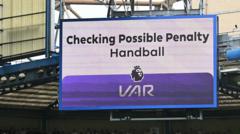
The experiment has failed. After years of promised "clear and obvious" corrections, the Video Assistant Referee (VAR) has managed to do the impossible. It’s united rival fanbases in a shared, simmering resentment. A recent Football Supporters’ Association (FSA) survey confirms what anyone sitting in a cold stadium on a Tuesday night already knew. Three-quarters of fans now oppose the use of VAR in the Premier League. That’s not a vocal minority. It’s a landslide.
When VAR first arrived, we were told it would end the "pub debates" about offsides and red cards. It didn't. Instead, it replaced those debates with forensic analysis of armpits and toenails. The soul of the game—the instant, unbridled joy of a goal—is being strangled by a guy in a windowless room in Stockbridge Woods. If you’ve ever stood in a terrace waiting three minutes for a green checkmark on a big screen, you know the feeling. It’s exhausting. It sucks the life right out of the stadium.
The FSA Data Proves the Discontent is Real
The numbers from the FSA National Supporter Survey are staggering. They reflect a deep-seated frustration that transcends simple "bad calls." Out of the thousands of match-goers polled, 75% want the system scrapped or significantly overhauled. Only a tiny fraction believe it has improved the game. This isn't just about whether a decision is correct. It’s about how the game feels.
Fan experience is at an all-time low. The survey highlights that supporters feel less "connected" to the matches they pay hundreds of pounds to attend. When a goal goes in, there’s a collective pause. Fans look at the referee. They look at the big screen. They wait. That moment of hesitation is the death of spontaneity. You can’t get that raw emotion back once a VAR official spends four minutes drawing lines on a screen.
Spontaneity is the Greatest Casualty
Football is a game of moments. It’s about that split second where the ball hits the net and the world explodes. VAR has turned that explosion into a slow burn of anxiety.
Consider the "stadium experience" vs the "TV experience." If you're watching at home, you get replays, commentary, and different angles. You’re part of the process. If you’re in the stands, you’re often left in the dark. You see a "Checking Goal" graphic and nothing else. You have no idea why the game has stopped. You don't see the replays. You're just a spectator in the literal sense, waiting for a remote authority to tell you if you can celebrate or not. It makes the live fan feel like a secondary concern to the global broadcast audience.
The Problem with Clear and Obvious
The original remit of VAR was to catch the "howlers." Think Thierry Henry’s handball against Ireland or Diego Maradona’s Hand of God. But the Premier League hasn't used it that way. We’ve drifted into a search for objective perfection in a game that is inherently subjective.
Referees are now terrified to make a call on the pitch because they know they have a safety net. This leads to delayed flags and hesitant officiating. The "clear and obvious" threshold has become a moving target. What one official thinks is a foul, another doesn't. Adding more technology hasn't removed human error; it has just moved the error to a different room.
The Financial and Cultural Cost
Premier League clubs recently voted on whether to scrap VAR entirely. While the motion didn't pass, the fact it was even on the table speaks volumes. The clubs are starting to realize that the product is being damaged.
- Time wasting: Games are regularly stretching past 100 minutes due to reviews.
- Player frustration: Players can't celebrate naturally, which affects their mental flow during a match.
- Referee de-skilling: On-field officials are losing the art of decisive officiating.
We are seeing a culture where the "correct" decision is valued over the "entertainment" of the sport. But football isn't a lab experiment. It’s a drama. If you take away the flow, you lose the essence of why people fell in love with it in the first place.
Why Semiautomated Offsides Won't Fix Everything
The Premier League is introducing semiautomated offside technology (SAOT) to speed things up. It’s meant to take the "human drawing lines" element out of the equation. While this might shave 30 seconds off a review, it doesn't solve the fundamental issue.
A goal scored by a millimeter of a jersey sleeve is still a goal ruled out for a millimeter of a jersey sleeve. Fans don't hate the time it takes as much as they hate the pedantry. Nobody goes to a game hoping to see a goal chalked off because a striker's lean gave them a microscopic advantage. SAOT is a band-aid on a broken limb. It makes the wrong thing happen faster.
The Path Forward for Fan Power
If 75% of fans are unhappy, the authorities can't ignore it forever. The FSA has been clear: the current implementation is broken. There are a few ways this could go.
One option is the "challenge" system used in tennis or cricket. Give managers two challenges per game. If they're wrong, they lose them. This puts the power back into the hands of the teams and limits the constant interference from a remote booth. Another option is a complete return to "referee’s word is final" for everything except goal-line technology.
Honestly, the best move might be the most radical one. Admit it didn't work. Move on. The game survived over a century without it and thrived.
If you want to make your voice heard, don't just moan on social media. Join a supporters' trust. Participate in the next FSA survey. Write to your club's fan liaison officer. The Premier League is a business, and if the customers are consistently reporting a bad experience, the business has to pivot. Start by supporting local fan-led initiatives that demand more transparency in how VAR decisions are communicated inside the stadium. Demand that the audio between the ref and the VAR be played live, just like in rugby. If we're going to have the technology, we should at least be allowed to hear the logic—or lack thereof—behind the calls.