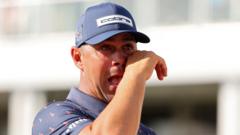
The victory walk at the 1,500-meter mark of a professional golf tournament usually feels like a formality for a major champion. For Gary Woodland, standing on the green after his recent win, it felt like an impossibility rendered real. This was not just another trophy for a mantelpiece already housing a U.S. Open cup. This was the first time Woodland had stood in a winner's circle since a surgeon reached into his skull to remove a lesion on his brain.
While the sports world loves a redemption arc, the technical and psychological reality of Woodland’s return is far grittier than the highlight reels suggest. He didn't just beat a field of elite golfers. He overcame a neurological crisis that threatened his motor skills, his memory, and his very sense of self. To understand this win, you have to look past the scoreboard and into the terrifying mechanics of a brain recovery that should have ended a career.
The Invisible Opponent in the Tee Box
Most professional athletes deal with structural failures. A torn ACL is a known quantity with a predictable timeline. Brain surgery is a different beast entirely. In 2023, Woodland began experiencing tremors and a crushing sense of fear that had no external cause. These were not the "nerves" of a Sunday afternoon at Pebble Beach. This was a chemical and electrical storm caused by a lesion pressing against the areas of his brain that regulate emotion and physical coordination.
The surgery to stabilize his condition involved more than just physical healing. When a surgeon navigates the gray matter, the risk isn't just "not playing golf again." The risk is losing the ability to sequence complex movements. A golf swing is a series of micro-adjustments happening in milliseconds. For Woodland, the "why" of his struggle wasn't a lack of practice. It was a literal rewiring of the connection between his intent and his hands.
Rebuilding the Neurological Map
The path back to the PGA Tour began in darkened rooms, not on driving ranges. For months, Woodland dealt with light sensitivity and the profound fatigue that follows neurological trauma. When he finally picked up a club, the muscle memory that had been his bedrock since childhood felt like a foreign language.
The sheer grit required to rebuild a world-class swing from scratch cannot be overstated. We often see athletes return from injury and expect them to be the same person. They rarely are. Woodland had to accept a new baseline. He had to learn how to manage the "brain fog" that occurs when the mind is forced to work twice as hard to perform tasks that used to be automatic.
Why This Win Defies Statistical Logic
In the modern era of golf, the game is dominated by young stars who treat their bodies like precision-tuned machines. The data suggests that once a player hits their late 30s and suffers a major health setback, the window for winning on the PGA Tour slams shut.
Woodland ignored the data. His win wasn't a fluke of a weak field or a lucky bounce. It was a clinical display of ball-striking that mirrored his 2019 peak. The difference now is the mental load. Every time he stands over a putt, he is fighting the memory of the tremors. Every long flight to a tournament is a reminder of the months he spent unable to drive a car.
The Myth of the Easy Comeback
Television commentators often frame these stories as "triumphs of the human spirit." While poetic, that narrative ignores the brutal, boring, and painful work of physical therapy. There were weeks where Woodland couldn't find the center of the clubface. There were days when the simple act of focusing on a target caused physical exhaustion.
The industry analyst sees a different story: a veteran player utilizing every resource—from neuro-specialists to swing coaches—to bridge the gap between "healthy enough to live" and "healthy enough to beat the best in the world." This wasn't just about spirit. It was about a sophisticated, multi-year medical and athletic strategy.
The Financial and Professional Stakes of a Health Crisis
Golf is a lonely business. Unlike the NFL or NBA, there are no guaranteed contracts if you can't play. If you don't tee it up, you don't get paid. Woodland's journey wasn't just a personal quest; it was a professional necessity.
The pressure to return while his medical exemption was still active added a layer of stress that would break most people. He was playing for his future, for his family, and for the right to prove that his identity wasn't defined by a diagnosis. The sports industry often treats players as assets, but Woodland reminded everyone that the most valuable asset is the mind.
A New Blueprint for Athlete Recovery
Woodland’s success provides a case study for how elite organizations and individual athletes handle catastrophic health events. It’s no longer just about ice baths and surgery. The "Woodland Model" involves:
- Integrated Neurological Support: Treating the brain's recovery with the same intensity as a muscle tear.
- Psychological Transparency: Being open about the fear and anxiety that accompanies brain trauma, rather than "toughing it out."
- Paced Re-entry: Not rushing back for a major, but building a schedule that allows the nervous system to adapt to the stress of competition.
This victory changes the conversation around what is possible for an aging athlete facing a non-orthopedic crisis. It proves that the "software" of an athlete—the brain—can be patched and updated even after a system-wide crash.
The Quiet Reality of the Winner’s Circle
When the final putt dropped, the cameras caught the tears and the hugs. Those are the images that sell magazines. But the real story is found in the quiet moments before the tournament began—the 4:00 AM wake-up calls, the medication schedules, and the terrifying thought that the old Gary Woodland might never come back.
He did come back. But he returned as a different version of himself. A version that understands that every swing is a gift and every win is a miracle of biology as much as it is a feat of skill. The trophy is heavy, but it’s nothing compared to the weight he’s been carrying since that first diagnosis.
The most dangerous man on the golf course is no longer the one with the fastest swing. It’s the one who has already stared down his own mortality and refused to blink. Woodland didn't just win a golf tournament. He reclaimed his life.
Go watch the replay of the 18th hole. Look at his hands. They aren't shaking anymore.