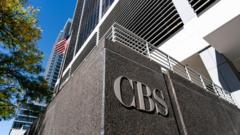
Nostalgia is a terminal disease in the media industry. For the last forty-eight hours, the digital wake for CBS News Radio has been a masterclass in performative grief. Critics and veteran broadcasters are clutching their pearls over the "end of an era," lamenting the loss of a hundred-year-old institution as if it were the burning of the Library of Alexandria.
They are wrong.
The shuttering of CBS News Radio isn't a cultural tragedy. It is a long-overdue accounting of reality. CBS isn't killing a vital service; they are finally unplugging a life-support machine that has been humming in an empty room for over a decade. The "lazy consensus" suggests that we are losing a pillar of democracy. The truth is that we are witnessing the inevitable collapse of a distribution model that became obsolete the moment the first iPhone shipped.
The Myth of the "Informed Public" via AM/FM
The primary argument from the mourners is that radio provides a unique, "essential" service for the masses. This is a fantasy.
Let’s look at the mechanics of the medium. Linear radio is the most inefficient way to transmit information ever devised for the modern age. You are a hostage to the clock. If you want the news, you wait for the top of the hour. If you miss the lead, it’s gone. You cannot click a citation. You cannot verify a source in real-time. You cannot share a specific segment with a friend without a clunky third-party recording.
In a world of $O(1)$ search complexity—where the cost of finding any piece of data is effectively constant—the $O(n)$ linear crawl of radio is a relic. People don't want "the news" at 9:00 AM. They want the specific truth about a specific event the microsecond it happens. CBS Radio was trying to sell a dial-up connection to a fiber-optic world.
I have sat in boardrooms where executives spent millions trying to "pivot" radio to digital. They always fail because they refuse to admit the core problem: The brand isn't the value. The convenience is. And radio is no longer convenient.
The Audience is a Ghost
The industry likes to cite "reach" statistics to justify its existence. They’ll tell you that 80% of adults still listen to terrestrial radio. This is the most dishonest metric in media.
"Reach" in radio terms often means someone sat in a car for twelve minutes and didn't bother to change the station while a CVS ad played. It doesn't mean engagement. It doesn't mean influence. It means background noise.
- Advertisers aren't stupid. They are moving to podcasts and localized digital streams because they want data, not "estimated impressions" from a Nielsen diary kept by a 70-year-old in a suburb.
- The talent drain is absolute. The smartest voices in journalism left the booths years ago. Why would a top-tier investigative reporter settle for a 40-second "wrap" on a signal that fades when you drive under a bridge? They wouldn't. They started Substacks. They joined high-budget podcast networks. They went where the agency is.
The "Golden Age" of radio ended when the car dashboard became a smartphone. Once Apple CarPlay and Android Auto became standard, the AM/FM button became the most ignored piece of real estate in the history of industrial design. CBS didn't lose its audience; the audience simply upgraded their hardware.
The Centralization Trap
The competitor's narrative suggests that losing CBS Radio leaves a vacuum in local reporting. This is a fundamental misunderstanding of how CBS operated.
CBS News Radio was a centralized feed. It was the epitome of "New York and DC telling the rest of the country what matters." If you want to talk about the death of local news, look at the hedge funds buying up local newspapers, not the closure of a national radio desk.
In fact, the death of these national dinosaurs might actually be the best thing to happen to local information ecosystems in years. When the "big voice" from the coast stops piped-in segments, it forces a realization: the infrastructure for local communication must be rebuilt from the ground up, not top-down.
The Cost of Sentimentalism
Maintaining a legacy radio network is obscenely expensive. You have satellite transponder leases, aging transmitter sites, union contracts designed for the 1970s, and a massive overhead of middle managers whose only job is to ensure the "beeps" happen at the right time.
Every dollar CBS spent on "saving" its radio service was a dollar it didn't spend on:
- Direct-to-consumer digital infrastructure.
- High-fidelity audio storytelling.
- Data-driven investigative units.
By holding on for 97 years, CBS wasn't being "loyal" to its heritage. It was being cowardly. It was afraid of the PR hit that finally came this week. A truly "cutting-edge" (a term I hate, but let’s use it for the irony) company would have transitioned this entire operation to a digital-first, on-demand powerhouse five years ago.
Imagine a scenario where CBS took the $100 million+ it wasted on terrestrial maintenance and built a proprietary, localized news app that used AI to narrate hyper-local stories for commuters based on their GPS coordinates. That is what a leader does. A follower just keeps the lights on until the bill collector arrives.
Stop Asking if "Radio is Dead"
You’re asking the wrong question. Radio isn't dead; it's just a feature now. It’s an app icon. It’s a voice command to a smart speaker. The mistake CBS made—and the mistake the "industry insiders" continue to make—is believing that the delivery mechanism is the product.
It’s not. The product is the information.
When you lose the delivery mechanism, you don't lose the product unless you were too lazy to build a new pipe. CBS was too lazy. They relied on the "prestige" of the Tiffany Network to carry them. But prestige doesn't pay for satellite time when your listeners are all using Spotify.
The "Public Safety" Fallacy
The final stronghold of the radio apologist is the "Emergency Alert" argument. "What happens during a hurricane when the cell towers go down?" they cry.
First, cell towers are increasingly more resilient than a single massive radio tower that can be toppled by the same wind. Second, the government has already moved to Wireless Emergency Alerts (WEA) that hit your phone regardless of your "station" preference.
The idea that we need to maintain a multi-million dollar national news apparatus so people can hear a weather update once every three years is a classic "sunk cost" fallacy. We don't keep steam engines running just in case the electric grid fails; we build better batteries.
The Inevitable Pivot
The closure of CBS Radio is a signal to every other legacy media company: the clock has run out. If your business model relies on a physical piece of spectrum granted by the FCC in 1934, you are already a ghost.
I have watched companies burn through their entire cash reserves trying to "modernize" without changing their culture. You cannot put a digital skin on a linear skeleton. It doesn't work. It just creates a more expensive way to fail.
CBS finally stopped the bleed. They should have done it in 2019. The fact that it took until 2024 (and the subsequent fallout in 2026) is a testament to the paralyzing power of tradition.
Stop mourning the death of a signal. Start demanding better from the content. If the news is worth hearing, it will find a way to your ears that doesn't involve a telescope or a spinning dial.
Build something new or get out of the way.