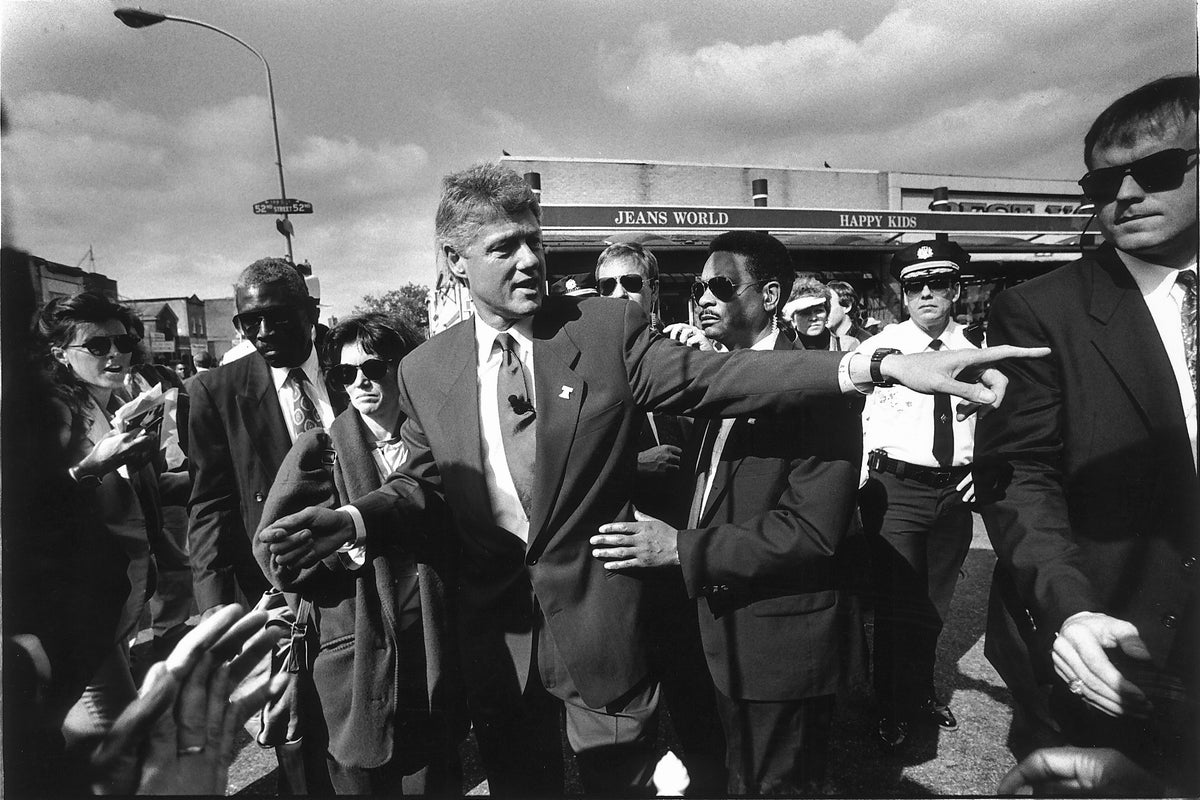
The deployment of historical analogy in contemporary geopolitical crises is rarely an act of academic comparison; it is a tactical effort to manipulate the cost-benefit analysis of military intervention. When Democratic leadership references the 1998 Iraq strikes—specifically the "Operation Desert Fox" era under the Clinton administration—to critique Republican-led escalations with Iran, they are not merely "bashing" a rival. They are attempting to re-establish a specific doctrine of Proportionality and Congressional Consent. This maneuver seeks to bridge the gap between two disparate eras of American power by leveraging a "callback" as a mechanism for political restraint.
The Mechanics of the Precedent-Based Critique
The efficacy of a historical callback depends on three operational variables: situational symmetry, legal continuity, and electoral risk mitigation. In the context of the U.S.-Iran tension, the use of the Clinton-era precedent serves as a defensive shield against accusations of being "weak on national security." By pointing to a moment when a Democratic president used force, the party establishes a baseline of "Responsible Hawkishness."
The current strategic environment is defined by a decay in the War Powers Resolution (WPR) effectiveness. The 1973 act, intended to check the executive branch's power to commit the U.S. to an armed conflict without consent, has been eroded by decades of "kinetic actions" that stop short of formal war declarations. The Democratic strategy involves re-indexing the 1998 strikes as the "correct" model of limited, objective-based intervention, contrasting it against what they characterize as the "unbounded" and "impulsive" escalation cycles observed in the 2020-2024 period.
The Strategic Asymmetry of Force
To understand the critique, one must quantify the difference between Punitive Strikes and Strategic Decapitation.
- Operation Desert Fox (1998): This was a four-day bombing campaign. Its objective was the degradation of Iraq's ability to produce and deliver weapons of mass destruction. It utilized a defined "Exit Trigger"—once the four days were up, the kinetic phase ceased.
- Modern Iran Escalations: The killing of high-ranking state officials, such as Qasem Soleimani, represents a shift from degrading assets to removing actors. This creates an unpredictable feedback loop.
The Democratic argument rests on the logic that the 1998 model maintained a "threshold of containment," whereas modern Republican strategies risk "systemic spillover." Systemic spillover occurs when an isolated strike triggers a regional realignment, forcing the U.S. into a "forever war" posture by accident rather than by design.
The Congressional Constraint Function
The core of the Democratic dissent is the Authorization for Use of Military Force (AUMF). There is a persistent legal friction between Article II of the Constitution (Presidential power as Commander-in-Chief) and Article I (Congressional power to declare war).
When critics invoke the 1990s, they are highlighting a period before the 2001 and 2002 AUMFs were "stretched" to cover operations across the Middle East and North Africa. The 1998 strikes were conducted under a different perception of international law and executive limits. By calling back to this era, Democrats are attempting to "sunset" the broad interpretations of the 2002 AUMF that have allowed successive administrations to bypass specific legislative approval for Iranian engagement.
The logic follows a strict flow:
- Step A: Identify a threat.
- Step B: Define the narrowest possible military objective.
- Step C: Secure legislative buy-in to distribute political risk.
- Step D: Execute and exit.
Modern critics argue that the current GOP approach skips Step C and obscures Step B, leaving the U.S. vulnerable to long-term "Mission Creep."
The Domestic Narrative Architecture
The use of historical callbacks also serves a domestic branding function. In a polarized electorate, the "Clinton Callback" acts as a signal to moderate voters. It suggests that the Democratic Party is not anti-war, but rather anti-unmanaged-war. This distinction is vital for maintaining the support of the "Suburban Centrist" demographic, which typically favors a strong military presence but fears the economic and social instability of a protracted regional conflict.
This creates a Bipolar Risk Profile:
- Democratic Risk: Appearing indecisive or paralyzed by process, leading to a perceived "deterrence deficit."
- Republican Risk: Appearing reckless or uncoordinated, leading to a "diplomatic deficit."
Operationalizing the Comparison: The Failure Points
The comparison to the 1990s has significant structural limitations that analysts often overlook. The geopolitical architecture of 1998 was unipolar; the U.S. operated with a degree of freedom that no longer exists in a multipolar 2026.
The first limitation is the Deterrence Decay. In 1998, Iraq was a sanctioned, isolated power with limited retaliatory options. Iran, conversely, operates an integrated "Axis of Resistance" comprising non-state proxies across Lebanon, Yemen, Iraq, and Syria. A "limited" strike today carries a 400% higher probability of a multi-theater response compared to 1998.
The second limitation is the Information Environment. The 1998 strikes were managed through traditional media cycles. Today, the "OODA Loop" (Observe, Orient, Decide, Act) is compressed by real-time social media and cyber-warfare. A president cannot "lean on a callback" effectively if the adversary can reshape the narrative on the ground before the first missile impacts.
The Calculus of Proportionality
Under International Humanitarian Law, proportionality requires that the "anticipated loss of life and damage to property incidental to attacks must not be excessive in relation to the concrete and direct military advantage anticipated."
Democrats argue that the 1998 strikes met this criteria because they targeted infrastructure. They argue that targeting high-level state leaders in 2020 and beyond violates the Escalation Dominance theory. Escalation Dominance suggests that for a strike to be successful, you must be able to control the next ten steps of the conflict. By removing a key negotiator or leader, the U.S. potentially loses the ability to "off-ramp" the crisis, making the initial strike strategically "disproportional" despite its tactical precision.
The Strategic Recommendation for Future Engagement
The reliance on historical callbacks is a useful rhetorical tool, but it is insufficient for a modern foreign policy framework. To move beyond the "Clinton vs. Trump" dichotomy, the U.S. must adopt a Dynamic Authorization Model.
This model requires:
- Objective-Specific Sunsets: Any military action initiated under Article II must have a 72-hour expiration unless ratified by a specialized Congressional "War Oversight Committee."
- Proxy-Integrated Deterrence: Acknowledging that Iran does not fight as a Westphalian state. Deterrence must be applied to the network, not just the state actor, to avoid the "decapitation trap."
- Economic-Kinetic Synchronization: Ensuring that every military strike is preceded by a pre-cleared package of secondary sanctions that can be deployed instantly to freeze the adversary’s ability to fund a counter-strike.
The objective is not to return to the 1990s, but to extract the Principle of Constraints from that era and apply it to the high-velocity conflict environments of today. The current Democratic strategy of referencing the past is a signal that they seek a return to "Predictable Power"—a state where allies and enemies alike can calculate U.S. responses with high certainty.
The immediate tactical move for policy architects is to draft a "New War Powers Framework" that specifically addresses the gray-zone tactics used by Iran. This framework must define "Cyber-Aggression" and "Proxy-Financing" as triggers for legislative consultation, thereby closing the loophole that allows the executive branch to engage in "forever skirmishes" without a clear mandate. The callback to Clinton is the opening argument; the legislative codification of these constraints is the necessary conclusion.
Would you like me to generate a comparative table of the legal justifications used in the 1998 strikes versus the 2020-2024 Iranian engagements to further clarify these jurisdictional gaps?