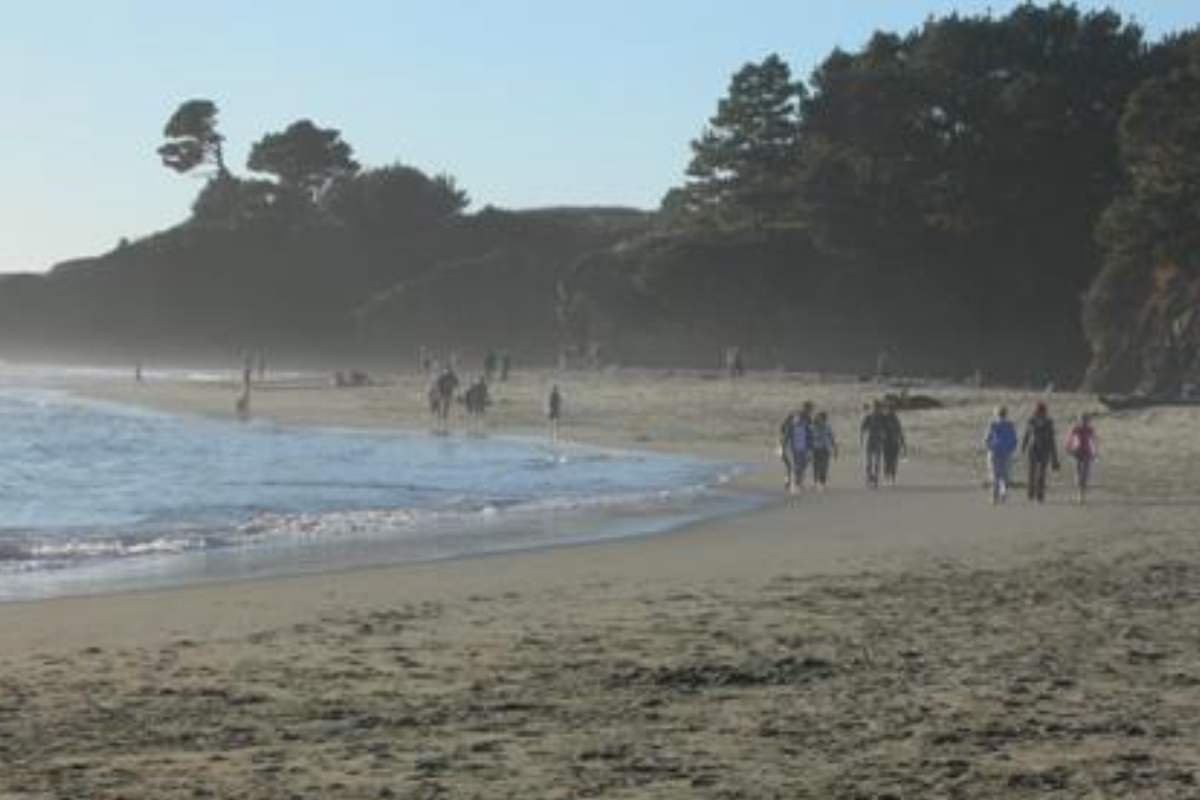
The Pacific Ocean does not have a voice, but it has a temperature. When that temperature hits the skin of a surfer paddling out past the break at Gray Whale Cove, it feels like an old, cold promise. The water off the San Mateo County coast isn't the postcard turquoise of a tropical getaway. It is a brooding, metallic green. It is thick with kelp that feels like reaching hands.
For a thirty-nine-year-old man on a quiet morning, this was home. He wasn't a tourist looking for a thrill. He was part of a specific tribe that wakes up before the sun to chase the energy of a storm that died a thousand miles away. You don’t paddle into those waters unless you respect the hierarchy. You are a guest. Sometimes, the host is hungry.
Silence.
That is the first thing a survivor mentions. Before the impact, before the salt-water spray, there is a moment where the natural rhythm of the ocean—the slap of the board against the chop, the cry of a gull—simply vanishes. It is as if the world holds its breath. Then comes the hit. It isn't a bite so much as a collision. A Great White shark doesn't nibble. It strikes with the force of a high-speed sedan, using its massive weight to stun its prey before the teeth even do their work.
The man felt the pressure first. Then the cold water turned strangely warm.
The Mechanics of the Deep
Great Whites are often misunderstood as mindless killing machines, but they are actually cautious, analytical predators. They operate on a biological cost-benefit analysis. Is this creature a high-fat seal that will fuel a migration to Hawaii? Or is it a fiberglass board and a neoprene suit that offers no nutritional value?
In this instance, the shark made a mistake. It happens more often than the headlines suggest. Scientists call it an "investigatory bite." The shark uses its mouth the way a human uses their hands—to feel, to understand, to identify. But when your mouth is lined with serrated, razor-sharp triangles and your jaw can exert a force of nearly 4,000 pounds per square inch, an "investigation" is a catastrophe.
The teeth tore through the wetsuit. They found the muscle of both legs. In that terrifying span of seconds, the hierarchy of the coastline was re-established. The surfer was no longer an athlete or a man with a career and a family; he was a biological entity struggling against a force that has remained unchanged for millions of years.
The Longest Paddle
Survival in the aftermath of an attack is a race against a clock made of blood. When the femoral artery is threatened, you don't have minutes. You have moments.
Consider the sheer psychological weight of that water. After the shark releases—which they almost always do once they realize a human is mostly bone and gristle—the victim is left in the "impact zone." The predator might be gone, or it might be circling beneath the surface, hidden by the murky depths. Every splash of the arms feels like an invitation. Every shadow in the kelp looks like a dorsal fin.
The man had to move. He had to paddle back toward a shore that suddenly felt miles away. The adrenaline that floods the system during an attack is a double-edged sword; it numbs the initial agony so you can function, but it also sends the heart into a frenzy, pumping blood out of the wounds faster.
He made it.
He reached the sand of Gray Whale Cove, a strip of beach tucked beneath steep, crumbling cliffs. It is a beautiful place, isolated and rugged, which makes it a nightmare for emergency responders. There is only one way down: a long, winding staircase. On this morning, those stairs represented the difference between a tragic headline and a miraculous survival story.
The Human Response
When the call went out, the machinery of civilization kicked into gear to counter the brutality of nature. CAL FIRE technicians and local paramedics didn't just see a patient; they saw a man whose life was leaking into the sand. They applied tourniquets—strips of reinforced fabric that are the only true defense against a shark’s "investigation."
The beach was evacuated. The State Parks department issued a mandatory closure. They posted the signs—stark, yellow warnings with the silhouette of a shark that look like something out of a movie but carry the weight of immediate danger. For forty-eight hours, the water was off-limits.
But why do we close the beach?
It isn’t because the shark is "stalking" humans. It’s because an attack creates a "dinner bell" effect. The blood in the water and the stress signals sent out by the struggle can attract other predators or keep the initial shark in a state of high alert. We close the beach to give the ocean time to forget. We give the ecosystem a chance to reset its pulse.
The man was airlifted to a trauma center. He was lucky. "Stable condition" is a clinical phrase that hides a grueling recovery of skin grafts, physical therapy, and the mental haunting that comes with knowing you were almost erased.
The Invisible Stakes
We live in an era where we feel we have conquered the planet. We map the globe with satellites. We build glass towers. We think we are the protagonists of every environment we enter.
Then a thirty-nine-year-old man goes for a morning surf and reminds us that there are still places where the old rules apply. The California coast is part of the "Red Triangle," a stretch of water from Monterey Bay up to the Farallon Islands and over to Bodega Bay. It is one of the most productive marine environments on Earth. It is also the primary hunting ground for the world’s largest predatory fish.
We share this space.
The surfer didn't blame the shark. Most people who spend their lives in the water don't. They understand that the risk is the price of admission. You pay in anxiety so you can buy the feeling of sliding down the face of a wave.
The beach at Gray Whale Cove eventually reopened. The yellow signs were taken down. The tourists returned with their umbrellas and their toddlers, staring out at the white caps and the shifting hues of green. They saw a scenic view. But for those who know the story, they saw something else. They saw a boundary.
The water looks the same as it did the day of the attack. It is still cold. It is still deep. Below the surface, the great shadows continue to move, patrolling a kingdom that does not recognize our laws or our names. They are not evil. They are simply there.
Somewhere, a man is looking at the scars on his legs. He is feeling the itch of healing tissue and the throb of a memory that will never quite dim. He is thinking about the next time the swell hits, and the wind turns offshore, and the water calls his name. He will go back. The human spirit is a stubborn thing, always choosing the thrill of the heights over the safety of the shore, even when it knows exactly what is waiting in the dark.
The ocean remains silent. It doesn't apologize. It just waits for the next set of waves to roll in from the horizon, indifferent to whether we are there to ride them or not.