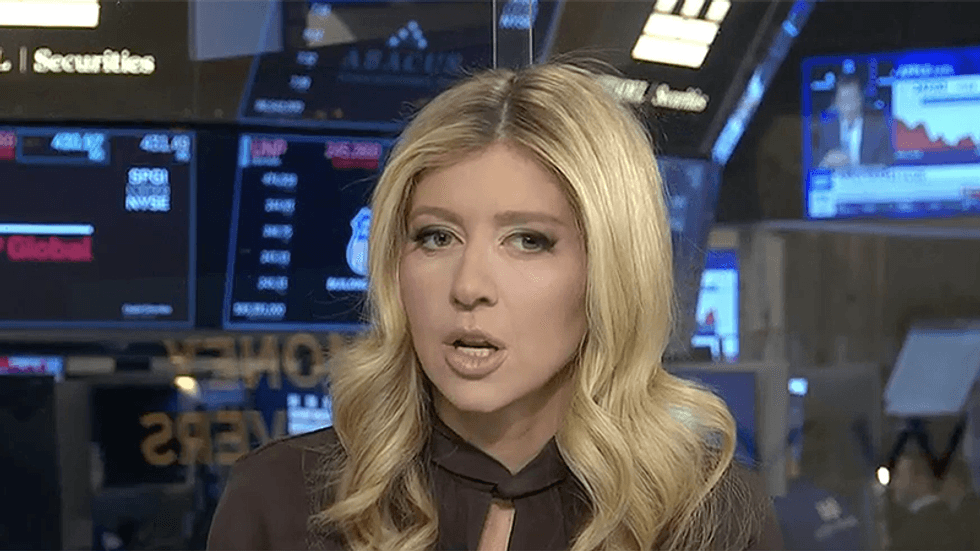
The internet's collective outrage over a CNBC host asking about the "upside" of a nuclear winter is a masterclass in performative morality. People love to feel superior by clutching their pearls at the mention of catastrophe. They call it "callous." They call it "out of touch." I call it the only honest question asked on financial television in a decade.
If you are an investor, your job is not to be a moral arbiter. Your job is to calculate the delta between current reality and a probable future. To suggest that certain outcomes are "too grim" to model is to admit you are a hobbyist, not a professional. The market doesn't care about your feelings, and it certainly doesn't care about the end of the world—unless that end can be priced. Recently making headlines lately: The Brutal Truth About the Strait of Hormuz Bottleneck.
The Myth of the Uninvestable Event
The "lazy consensus" dictates that a nuclear exchange is the "end of history," making any financial planning moot. This is a comforting lie. It allows people to ignore the gritty, technical reality of survival and recovery. History shows that even in the face of total systemic collapse, value doesn't vanish; it just migrates.
During the Black Death, the labor shortage fundamentally broke the feudal system, leading to a massive spike in real wages for the survivors. After the firebombing of Dresden, the rebuilding process created entirely new industrial centers. Destruction is a reset button, and capital always finds a way to flow through the cracks. Additional details into this topic are explored by Harvard Business Review.
When we talk about nuclear winter, we are talking about a specific set of physical constraints:
- Substantial drop in global temperatures.
- Massive disruption of the hydrological cycle.
- Total collapse of traditional agricultural supply chains.
- Near-instantaneous shift to localized, indoor, or subterranean production.
If you aren't looking at the companies positioned to dominate those four realities, you aren't doing your job.
The Thermodynamics of Profit
Let’s dismantle the premise that there is no "upside." In a world where the sun is obscured by soot and the average temperature drops by $10°C$ to $20°C$, energy isn't just an asset; it is the only currency that matters.
The "upside" isn't for the people dying; the upside is for the infrastructure that survives. We are talking about a pivot from globalized trade to hardened, autarkic nodes.
1. The Death of Photovoltaics and the Rise of Small Modular Reactors (SMRs)
The ESG crowd has spent years pumping money into solar. In a nuclear winter, your solar farm is a graveyard of useless silicon. The investment thesis shifts instantly to nuclear energy—specifically SMRs. These are compact, can be buried deep underground, and operate independently of atmospheric conditions. Companies like NuScale or Rolls-Royce SMR aren't just energy plays; they are life-support plays.
2. The Vertical Farming Hegemony
Traditional wheat belts in the Midwest or Ukraine become permafrost. The "upside" here is a total monopoly for indoor, climate-controlled agriculture. We are talking about LED-driven, hydroponic environments that don't rely on the sun or rain. The companies that own the patents on nutrient solutions and high-efficiency lighting become the new ADM and Cargill.
3. Hardened Logistics and Deep-Crust Mining
Surface transport becomes a nightmare. The value of subterranean infrastructure—tunnels, bunkers, and deep-well water extraction—skyrockets. The expertise held by specialized boring and mining firms becomes the most sought-after engineering skill set on the planet.
Why the Outrage is Actually a Buy Signal
The vitriol directed at that CNBC host is a classic sentiment indicator. When the public reacts with visceral disgust to a line of questioning, it usually means the question has touched a raw, unexamined truth. The herd is terrified of the "Upside" because it forces them to acknowledge that life—and commerce—continues under even the most horrific conditions.
I’ve spent twenty years in rooms where we model "tail risks." I've seen funds lose billions because they refused to hedge against "unthinkable" scenarios. The most dangerous phrase in finance is "that could never happen." It happened in 1914. It happened in 1939. It happened in 2020.
If you aren't willing to look at a map of a cooling earth and ask, "Who owns the indoor air filtration patents?" you are a victim of your own empathy. Empathy is a virtue in a neighbor, but a liability in a fund manager.
The Mathematics of the Worst-Case Scenario
Let's look at the actual physics. A nuclear winter isn't a permanent state of extinction; it's a multi-year or multi-decade climatic event.
$$\Delta T = \alpha \cdot \ln(C/C_0)$$
While the above usually applies to greenhouse gases, the inverse forcing of soot in the stratosphere creates a temporary, brutal contraction. The recovery phase of that contraction is where the greatest wealth transfer in human history will occur.
Imagine a scenario where the global population is reduced by $50%$. The remaining $50%$ are concentrated in "Life Zones"—latitudes or underground facilities that can maintain habitability. The land value in those zones doesn't just go up; it becomes infinite. The technology required to maintain those zones becomes the most valuable intellectual property ever created.
Is it "gross" to talk about this? Sure. Does that make the math wrong? No.
The Counter-Intuitive Truth About "Safety"
Most people think buying gold or "prepping" is the way to play a collapse. They’re wrong. Individual prepping is a hobby. Institutional survival is an industry.
The real upside lies in the firms that provide the backbone for "The Continuity of Everything." This includes:
- Encrypted, satellite-independent communication networks.
- Synthetic biology for rapid-growth, low-light crops.
- Robotic maintenance for hazardous environments.
If you are holding a "balanced portfolio" of retail stocks and tech giants that rely on consumer discretionary spending, you are the one being irrational. You are betting on a permanent status quo that has never existed in the history of our species.
The CNBC host wasn't being a monster. He was being a fiduciary. He was asking the question that every person with a pension, a 401k, or a brokerage account should want answered: "If the world breaks, what is left that works?"
Stop Avoiding the Dark
The moral posturing against "catastrophe capitalism" is a luxury for those who don't understand how the world stays powered. Every major technological leap in the last century—from the internet to GPS to jet engines—was birthed from the "upside" of military conflict or the fear of total annihilation.
We live in a world built on the scrap metal of previous disasters. To pretend that a future disaster won't have a balance sheet is more than just naive—it's a dereliction of duty.
The next time you see a talking head get "torn apart" for asking a difficult question, look closely at who is doing the tearing. It’s usually the people who are the least prepared for a change in the weather. They want the world to stay the same because they don't have the stomach to profit from its evolution.
Don't be them. Price the soot. Hedge the cold. Invest in the survival of the species, because even in a nuclear winter, someone has to own the heaters.
The market doesn't end. It just changes its venue.