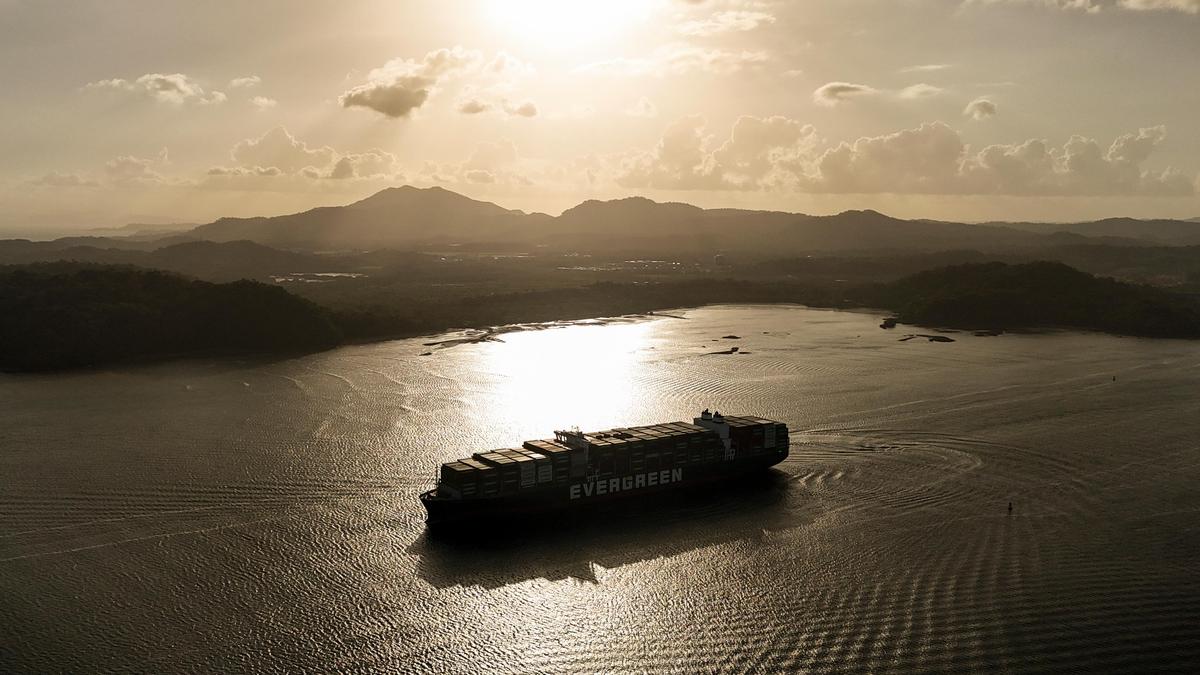
The Panama Canal currently operates at the intersection of hydrological constraints and a radical shift in global maritime energy flows. When conflict in the Middle East—specifically involving Iranian-backed threats to Red Sea transit—diverts Liquified Natural Gas (LNG) vessels toward the Americas, the Canal’s fixed capacity becomes a zero-sum game. This is not merely a "busy" period for the waterway; it is a structural collision between climate-driven draught restrictions and an inelastic spike in demand for Western Hemisphere transit. Understanding the current crisis requires deconstructing the Canal’s operational ceiling and the cascading effects of global energy rerouting.
The Physical Limits of the Trans-Isthmian Bridge
The Panama Canal’s capacity is governed by a strict water balance equation. Unlike sea-level canals like Suez, the Panama Canal relies on the freshwater of Gatun Lake to raise and lower ships through a series of locks. Each transit of the Neopanamax locks consumes approximately 50 million gallons of freshwater, which is then discharged into the sea.
The current operational bottleneck is defined by two primary variables:
- Hydrological Recharge Rate: The ability of the watershed to replenish Gatun Lake via rainfall. Recent El Niño cycles and shifting precipitation patterns have lowered the lake levels toward historical minima, forcing the Panama Canal Authority (ACP) to reduce daily transit slots from a standard 36 down to as low as 22-24 in peak drought periods.
- Draught Allocation: As water levels drop, the ACP reduces the maximum draught (the distance between the waterline and the bottom of the hull). For every foot of draught lost, a Neopanamax vessel may lose the capacity to carry several hundred containers or thousands of tons of bulk cargo, forcing a "light-loading" strategy that destroys per-voyage profitability.
The Red Sea Deflection and LNG Volatility
The escalation of hostilities in the Red Sea has effectively closed the Suez Canal to many Western energy shippers. For LNG tankers traveling from the U.S. Gulf Coast to Asian markets (China, Japan, South Korea), the Suez Canal was traditionally the preferred route due to its lack of lock-based congestion and lower transit fees compared to the Cape of Good Hope.
With the Suez route compromised by security risks, the Panama Canal becomes the only viable "short" route. However, the Canal’s booking system treats LNG vessels differently than scheduled container liners. LNG carriers often operate on "tramp" or spot-market schedules rather than fixed rotations. When these vessels arrive at the Isthmus without pre-booked slots, they enter a high-stakes auction environment.
The Cost Function of Transit Arbitrage
The decision-making process for an LNG vessel captain or fleet manager now involves a three-way cost comparison:
- The Auction Premium: In periods of high congestion, the ACP auctions off "excess" slots. These have historically climbed to over $4 million per transit, in addition to standard toll fees.
- The Cape of Good Hope Penalty: Rerouting around the tip of Africa adds approximately 10 to 14 days of sailing time. This increases fuel consumption (bunkering costs) and ties up the vessel, preventing it from taking on its next contract (opportunity cost).
- The Inventory Carry Cost: LNG is a cryogenic cargo. Even with modern reliquefaction plants, "boil-off"—where a small percentage of the gas evaporates during the journey—represents a direct loss of product. Longer voyages around Africa exacerbate this loss.
The Neopanamax Displacement Hierarchy
The Panama Canal’s current "top capacity" status creates a hierarchy of displacement. Because the ACP prioritizes high-margin, scheduled traffic, the burden of the bottleneck falls unevenly across different maritime sectors.
Container Liners (The Protected Class)
Major shipping lines like Maersk or MSC book slots months in advance. They are the "anchor tenants" of the Canal. While they suffer from draught restrictions (carrying fewer containers per ship), they rarely face the total exclusion currently threatening the energy sector.
LNG and LPG Carriers (The Displaced Class)
These vessels require the Neopanamax locks. Because the U.S. has become the world’s leading LNG exporter, particularly from terminals in Louisiana and Texas, the inability to pass through Panama is a direct hit to U.S. energy export efficiency. When the Canal is at capacity, these ships are forced into the Cape of Good Hope route, which effectively reduces the global "effective supply" of LNG carriers by keeping them at sea longer.
Dry Bulk and Tankers (The Marginalized Class)
Smaller bulk carriers moving grain or minerals are increasingly pushed back to the older, smaller Panamax locks or forced to wait for weeks in the "Panama bight." For these low-margin cargoes, the auction system is economically inaccessible.
Infrastructure as a Geopolitical Lever
The Canal’s capacity constraint acts as a force multiplier for geopolitical instability. When Iran-aligned forces disrupt the Bab al-Mandab Strait, they are not just attacking a single waterway; they are stress-testing the global maritime network's redundancy.
The Panama Canal’s "top capacity" means there is zero "surge capacity" in the global system. In classical network theory, a system operating at 95% capacity or higher will experience exponential delays when a minor disruption occurs. By forcing Red Sea traffic toward a drought-stricken Panama, the geopolitical actors in the Middle East have effectively induced a "buffer exhaustion" in global logistics.
Structural Response: The Land Bridge Alternative
The ACP and the Panamanian government are currently evaluating the "Multimodal Dry Canal." This involves offloading containers at one end of the isthmus, transporting them by rail or truck to the other side, and reloading them onto a different vessel. While this solves the water-use problem, it introduces massive "friction costs":
- Increased labor costs for stevedoring.
- Risk of cargo damage during double-handling.
- The requirement for "twin" fleets on both the Atlantic and Pacific sides.
For LNG, a "dry canal" is impossible. There is no pipeline across the isthmus with the capacity to handle the volumes required to bypass the locks. Therefore, the energy sector remains uniquely tethered to the physical water levels of Gatun Lake.
The Logistics of the "New Normal"
Strategic planning for the next 24 months must account for the fact that Panama’s capacity is no longer a constant; it is a seasonal variable. The ACP is investing in the Rio Indio reservoir project, which would provide a new source of freshwater for the locks. However, this is a multi-billion dollar, multi-year engineering feat that offers no relief for the current energy transit crisis.
Operational reality now dictates a "Two-Ocean" strategy for commodity traders. Instead of relying on the fluidity of the Panama Canal, firms are increasingly localizing supply chains. This includes:
- Arbitrage Reversal: U.S. LNG increasingly flows toward Europe (shorter, Canal-free route) while Middle Eastern gas, despite the risks, is forced toward Asia, reversing the traditional flow patterns to minimize the need for the Panama bottleneck.
- Vessel Sizing: A shift back toward smaller vessels that can utilize the older Panamax locks, though this sacrifices the economies of scale provided by Neopanamax carriers.
- Extended Contract Lead Times: The death of the "spot market" for Canal transit. Shippers must now value "transit certainty" over "price optimization."
The Panama Canal’s current state is the definitive case study in "Systemic Fragility." The convergence of a localized climate event (drought) and a distant geopolitical event (Red Sea conflict) has transformed a 50-mile strip of water into the world’s most significant economic choke point.
The immediate strategic imperative for global energy shippers is the abandonment of the "Just-in-Time" arrival model at the Isthmus. Operators must quantify the "Drought Premium" as a standard line item in voyage estimates. Until the Rio Indio reservoir or similar hydrological interventions are complete, the Panama Canal will function not as a reliable highway, but as a high-priced, restricted-access bridge. Firms that fail to price in the probability of a 14-day Cape of Good Hope detour will find their margins evaporated by the next auction cycle. The waterway is full, and the price of entry is no longer just a toll—it is a geopolitical tax.
Monitor the Gatun Lake level at the 80-foot mark. Below this threshold, the ACP historically triggers the most aggressive draught and slot restrictions. If lake levels do not see a sustained recovery during the next rainy season, the "top capacity" mentioned by the Canal chief will become a permanent ceiling, forcing a structural revaluation of the U.S.-Asia energy corridor.