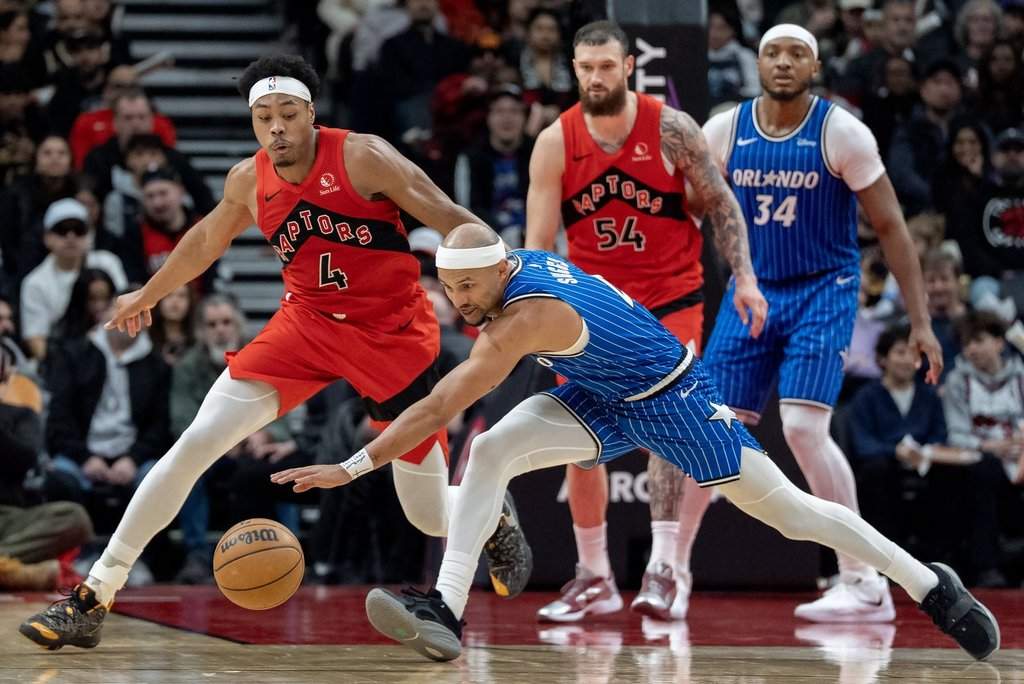
The scoreboard at Scotiabank Arena flickered with numbers that felt like a glitch in the simulation. 139–87. A fifty-two-point gap. In the NBA, a league defined by the world’s most elite biological specimens, a fifty-two-point deficit isn't just a loss. It is a dismantling. It is a public interrogation of your soul.
I sat three rows back from the Orlando Magic bench as the fourth quarter ticked away, and the sound wasn’t what you’d expect. Usually, a blowout of this magnitude is a riot of cheering. But by the final six minutes, the Toronto crowd had transitioned from bloodlust to a strange, hushed awe. They were watching a group of professional athletes—men who have been the best at everything they’ve done since they were six years old—simply run out of answers.
The air in an arena changes when a game turns into a massacre. It gets thin. Every missed layup from a Magic player felt like a heavy stone dropped into a still pond, the ripples of embarrassment stretching toward the rafters. On the other side, Scottie Barnes moved like he was playing a different sport entirely.
The Alpha in the High Post
Basketball is often sold as a game of shooting, but it is actually a game of space and psychological real estate. Scottie Barnes spent forty-eight minutes annexing every square inch of the floor.
He finished the night with a stat line that looks like a fever dream, but the numbers don’t capture the way he stared down the Orlando perimeter defenders. There is a specific kind of arrogance required to lead a romp like this. It isn’t loud or trash-talk heavy. It’s the arrogance of knowing exactly where the help defense is going to be before they even move. Barnes wasn't just scoring; he was conducting an orchestra where the Orlando Magic were the unwilling instruments.
He operated in the high post like a grandmaster. A shoulder shimmy here, a no-look kick-out there. Every time Orlando tried to tighten the screws, Toronto found a backdoor cut. The lead grew from ten to twenty, then twenty to forty, and eventually, the fifty-point threshold was crossed like a grim milestone.
Consider the hypothetical rookie sitting on the end of the Magic bench. Let's call him Marcus. Marcus has spent his life being the hero. He was the king of his high school, the star of his campus. Now, he’s watching his veteran teammates—men he viewed as gods—get beaten to every loose ball. He’s watching the Raptors’ bench players come in and play with the same ferocity as the starters, because when you’re up by forty, the game becomes about pride and the hunger for minutes. For Marcus, this isn't just a game on the schedule. It’s a crisis of faith.
The Anatomy of a Collapse
Why does a professional team lose by fifty-two?
It’s rarely about a lack of talent. Orlando has length. They have speed. They have shooters. But basketball is a fragile ecosystem of momentum. When Toronto went on their initial second-quarter run, the Magic didn't just miss shots; they stopped trusting the system.
A team is a collective of five minds trying to function as one. When the pressure of a defensive juggernaut like Toronto starts to mount, those five minds begin to fracture. Players start trying to "save" the game individually. They take contested threes. They drive into traffic. They stop talking on defense.
Toronto smelled that blood early.
The Raptors didn't just play well; they played with a terrifying lack of mercy. They forced turnovers that led to breakaway dunks that shook the stanchions. They hit corner threes that felt like daggers even when the game was already decided. It was a clinic in "transition offense," but that’s a clinical term for something much more visceral: it was a sprint against a team that had forgotten how to run.
The Human Cost of the Romp
We often treat athletes like avatars in a video game, but the locker room after an 87-point performance is a heavy place. There is no music. The athletic trainers wrap ankles in a silence so thick you can hear the velcro rip.
For the Raptors, the 139 points represent a ceiling being shattered. It’s a statement to the rest of the league that the North isn't just rebuilding; they’re reloading. Barnes is the fulcrum of that shift. He’s no longer the "promising young piece." He is the gravitational constant around which the entire franchise orbits.
But for Orlando, the journey home is a long one.
Imagine the plane ride. The flickering light of tablets as players rewatch the film, seeing themselves get outworked over and over. They see the moments where they gave up on a play. They see the moments where Scottie Barnes smiled as he crossed half-court. That film doesn't just show mistakes; it shows a lack of will.
The score 139–87 will be etched into the record books, a statistical anomaly that will pop up on trivia nights. But for the people in that building, it was something else. It was a reminder that in the NBA, the distance between "competitive" and "obliterated" is much smaller than we think. It only takes a few minutes of lost focus, a few missed rotations, and a superstar like Barnes who refuses to take his foot off the gas.
The game ended not with a bang, but with a lingering sense of discomfort. The final buzzer sounded, and the Raptors walked off the court with the casual gait of men who had just finished a light workout. They didn't celebrate much. You don't celebrate when you've done exactly what you were born to do.
Across the hardwood, the Magic players lingered for a second, looking at the giant LED screens as if hoping the score might change if they stared long enough. It didn’t. The 52-point ghost stayed right where it was.
In the tunnels beneath the stands, the echoes of the crowd started to fade, leaving only the sound of squeaking sneakers and the heavy, rhythmic breathing of men who had been thoroughly, undeniably broken.
The lights dimmed, the floor was mopped, and the arena prepared for the next night, but the stench of that fifty-two-point gap would linger in the vents for a long time.
Somewhere in the back, a janitor swept up a discarded stat sheet, the ink still fresh, the numbers still screaming.
Would you like me to analyze the historical context of 50-point blowouts in the NBA to see how teams usually recover the following week?