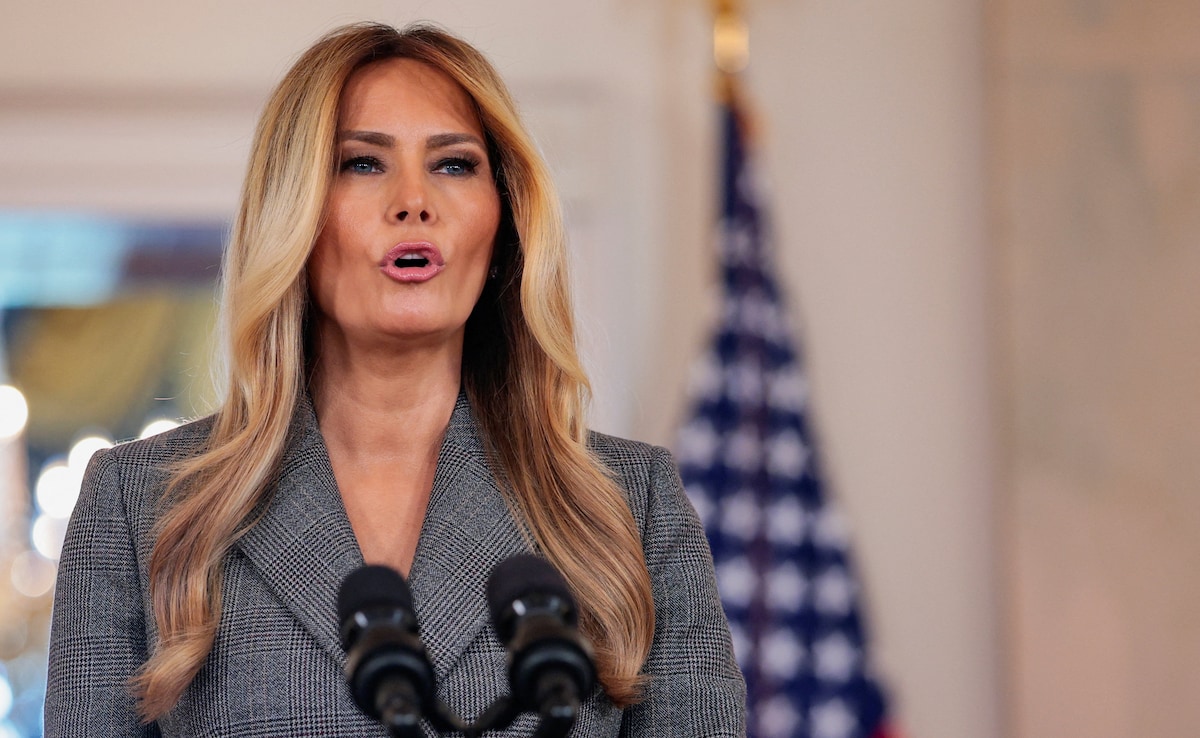
Melania Trump stood at a White House podium on Thursday and did something the political world rarely sees: she addressed the ghost of Jeffrey Epstein head-on. In a six-minute televised statement, the First Lady flatly denied ever having a personal relationship with the deceased sex offender or his accomplice, Ghislaine Maxwell. She framed the persistent online rumors linking her to the pair as "baseless lies" and "defamatory smears" designed to damage her reputation for political and financial gain. By calling for a public Congressional hearing for Epstein’s victims, she attempted to flip the script, moving from a defensive posture to a demand for a final, public accounting of the financier’s network.
The move was a calculated risk that effectively ended weeks of quiet speculation following the release of Department of Justice files earlier this year. Those documents contained a 2002 email exchange between a "Melania" and Maxwell, signed "Love, Melania," which the First Lady now characterizes as mere "casual correspondence." While the statement aimed to provide a clean break from the past, the sudden nature of the address—and reports that President Donald Trump was unaware she was making it—has instead reopened a door many in the administration hoped was bolted shut.
The Geography of Social Overlap
To understand the First Lady’s predicament, one must look at the specific social geography of New York and Palm Beach in the late 1990s and early 2000s. In these circles, Epstein was not a pariah; he was a fixture. Melania Trump, then Melania Knauss, entered this world in 1998 after meeting Donald Trump at a Fashion Week party. Her defense rests on the reality that in high-society Manhattan, being in the same room as someone does not equate to being in their inner circle.
"Donald and I were invited to the same parties as Epstein from time to time," she noted, highlighting that "overlapping in social circles is common." This is a verifiable truth of the era. Photographs exist of the Trumps, Epstein, and Maxwell at Mar-a-Lago in 2000 and at a Dolce & Gabbana event in 2002. However, the First Lady’s specific denial targets the more salacious "origin story" popularized by figures like Hunter Biden: the claim that Epstein himself introduced her to Donald Trump. By labeling this a "smear," she is drawing a hard line between social proximity and institutional involvement.
The Email Evidence
The most complicated piece of the puzzle remains the October 2002 email. Sent shortly after New York Magazine published a flattering profile of Epstein, the note praised the "nice story" and was signed with a familiar warmth. In her statement, the First Lady dismissed the exchange as "polite" and "trivial."
From a legal standpoint, her dismissal is strategic. A "casual correspondence" is harder to weaponize in a defamation suit than a deep personal history. Yet, the timing of the email—sent during the very week Epstein was being publicly celebrated before his first legal downfall—shows how deeply integrated the financier was with the New York elite. For Melania, the challenge isn't proving she didn't know Epstein; it's proving that her knowledge of him was as superficial as she now claims.
Legal Warfare as Reputation Management
This is not the first time the First Lady has used the legal system to guard her biography. In 2025, her legal team targeted Hunter Biden and various media outlets with billion-dollar lawsuit threats over claims that she was "scouted" or introduced by Epstein. These weren't just idle threats. The Daily Beast and political strategist James Carville both issued retractions or apologies after receiving letters from her attorney, Alejandro Brito.
This "scorched earth" approach to defamation serves two purposes. First, it creates a "chilling effect" for mid-tier media outlets that might otherwise repeat unverified rumors. Second, it prepares the ground for a potential lawsuit against the Epstein estate itself—a move Donald Trump suggested in early 2026. By positioning herself as a victim of a "twisted game" of misinformation, she is attempting to decouple her brand from the broader, more toxic Epstein narrative that still clings to her husband’s past.
The Congressional Gambit
Perhaps the most surprising element of the Thursday statement was the call for public hearings. By urging Congress to take sworn testimony from Epstein’s survivors, Melania Trump is making a high-stakes play for transparency. This move has found unexpected allies, including Democratic Representative Ayanna Pressley, who has long sought such a forum.
If these hearings happen, they could go one of two ways. They might finally provide the survivors the public platform they deserve, potentially clearing those who were merely social acquaintances. Conversely, they could invite a level of scrutiny into the 1990s New York social scene that the White House is not prepared to handle. It is a classic "all-in" move.
A Divergence in Strategy
The most jarring detail of the week was the apparent lack of coordination within the White House. While a spokesperson initially claimed the President was aware of his wife's plans, Donald Trump later told reporters he "didn't know anything about" the statement before it happened. This suggests a First Lady operating with an unprecedented level of independence.
Melania Trump has always been a disciplined communicator, often choosing silence over the chaotic messaging of her husband’s social media feeds. This break from silence indicates that she views the Epstein rumors not just as a political annoyance, but as an existential threat to her personal legacy. She is no longer waiting for the administration's comms team to defend her; she is taking the podium herself.
The Epstein shadow is long, and for those who navigated the gilded ballrooms of the 2000s, it is nearly impossible to escape entirely. Melania Trump’s strategy is to step directly into the light, banking on the hope that total transparency—and the threat of massive litigation—will finally burn the shadow away. Whether the public, or the legal system, accepts her version of "casual correspondence" will determine the final chapter of her public life.
The next move belongs to the House Oversight Committee. If they grant her request for a public hearing, the "Melania Protocol" will face its ultimate test under oath.


