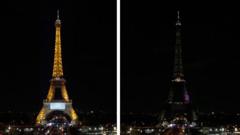
Earth Hour serves as the largest voluntary mass-participation event in history, yet its primary value is often miscalculated by observers who focus on immediate kilowatt-hour reduction. The event functions not as a utility-scale load-shedding mechanism, but as a global synchronization protocol designed to quantify collective intent. To evaluate the efficacy of turning off the lights at iconic landmarks like the Eiffel Tower or the Sydney Opera House, one must look past the superficial darkness and analyze the three specific vectors of impact: grid stability and the "duck curve" phenomenon, the signaling value of symbolic brownouts, and the risk of moral licensing in climate policy.
The Engineering Reality of Load Variability
Grid operators do not view Earth Hour as a reduction in carbon emissions; they view it as a predictable volatility event. When millions of households and landmarks simultaneously disconnect lighting loads, the sudden drop in demand creates a "down-ramp" that must be managed with surgical precision.
The electrical grid is a zero-sum system where supply must meet demand in real-time. A massive, coordinated drop in demand requires power plants—often gas-fired peaker plants—to throttle back rapidly. This rapid modulation can actually decrease the thermal efficiency of those plants, leading to a higher carbon intensity per unit of energy produced during the ramp-down and subsequent ramp-up phases.
The primary technical constraints during this 60-minute window include:
- Rotational Inertia: Large-scale synchronized shutdowns reduce the physical momentum within the grid, making it more susceptible to frequency fluctuations.
- Operating Reserves: Utilities must maintain "spinning reserves" to account for the certainty that those lights will be switched back on at the 61st minute, essentially idling carbon-heavy infrastructure rather than decommissioning it.
- Voltage Regulation: Massive load shifts in urban centers like London or New York can lead to localized voltage spikes if transformers and capacitor banks are not adjusted in anticipation.
The Signaling Value of Landmark Darkness
The power of Earth Hour lies in its function as a high-visibility, low-friction signal. For a corporation or a municipal government, turning off the lights on a skyscraper or a monument is an act of "costly signaling." While the actual cost of the saved electricity is negligible, the public coordination required to darken a national monument carries significant administrative and reputational weight.
This creates a Hierarchy of Participation:
- Passive Participants: Residential users who switch off non-essential lights. The data value here is high for social scientists tracking public sentiment, but the electrical impact is fragmented.
- Institutional Participants: Commercial real estate owners who darken skylines. This signals to shareholders and tenants a commitment to ESG (Environmental, Social, and Governance) frameworks, regardless of the building's actual LEED certification status.
- National Landmarks: Iconic structures that serve as the "nodes" in the global visual network. When the Burj Khalifa goes dark, it provides the necessary visual proof for a digital-first audience, turning a physical event into a viral asset.
The conversion of kilowatt-hours into media impressions is the true objective of the World Wide Fund for Nature (WWF). In this framework, Earth Hour is a marketing funnel. The "Top of Funnel" (ToF) is the visual spectacle of a dark city, while the "Bottom of Funnel" (BoF) is the conversion of that attention into legislative lobbying or long-term behavioral changes like retrofitting HVAC systems with variable speed drives.
The Moral Licensing Bottleneck
A critical risk in the Earth Hour framework is the psychological phenomenon of moral licensing. This occurs when an individual or institution performs a small, "virtuous" act, which then justifies a subsequent lack of action on more difficult, high-impact changes.
If a citizen feels they have "done their part" by sitting in the dark for an hour, they may be less likely to support aggressive carbon taxes or invest in expensive home insulation. This creates a bottleneck in climate progress. The data suggests that while symbolic actions increase awareness, they do not have a linear correlation with structural policy shifts.
The disconnect is quantifiable:
- Lighting Loads: In the 21st century, the transition to LED technology has significantly reduced the percentage of total energy consumption attributed to lighting. In most developed nations, lighting accounts for less than 15% of residential energy use.
- The Big Three: Heating, cooling, and transportation represent the vast majority of carbon footprints. Earth Hour, by focusing on lighting, ignores the thermal and kinetic energy demands that drive the bulk of global emissions.
To move past this bottleneck, Earth Hour must evolve from a "lights-off" event into a "systems-off" audit. Instead of merely darkening a room, participants would ideally use the hour to audit their digital and thermal footprints—checking the efficiency of their server racks, the insulation of their windows, or the optimization of their logistics routes.
Structural Optimization vs. Symbolic Gesture
The utility of Earth Hour is often debated through the lens of "Greenwashing." However, a more rigorous analysis suggests it is a necessary part of the Cultural Adoption Curve. Technological shifts—like the transition from internal combustion to electric vehicles—require a cultural "permission" phase. Earth Hour provides the social proof that a low-energy future is not only possible but desirable.
The most effective participants are those who use the event as a diagnostic tool. For a data center, a 60-minute test of "non-essential" system shutdown provides valuable data on power distribution units and cooling redundancies. For a city, it reveals the baseline energy consumption of street lighting and emergency infrastructure that cannot be switched off.
A Strategic Framework for Genuine Impact
To extract actual value from symbolic events, organizations must move away from performative darkness toward structural transparency. This involves three specific actions:
- Data Transparency: Instead of just turning off the lights, institutions should publish their real-time energy usage dashboard during the hour. This highlights the "baseload" that remains active, identifying the constant energy drains that need technological intervention.
- Operational Audits: Use the hour as a scheduled downtime for a "Waste Audit." Identify every machine, light, and climate-control unit that was left on and determine if its operation was mission-critical.
- Capital Reinvestment: Calculate the (admittedly small) savings from the power reduction and commit to reinvesting ten times that amount into permanent efficiency upgrades, such as smart thermostats or heat pump installations.
The strategic play for any entity participating in Earth Hour is to treat the event as a baseline measurement, not a solution. The goal is not to have one hour of darkness, but to use that hour to identify the structural inefficiencies that persist during the other 8,759 hours of the year. Focus your resources on the invisible energy—the industrial heat and the server-side cooling—rather than the visible lighting that serves as little more than a billboard for intent. Use the next 365 days to automate the efficiencies that Earth Hour only manages to highlight for sixty minutes.