The dirt under a Greek sun doesn't just crumble; it breathes. It carries the scent of wild thyme, baked clay, and a silence so heavy it feels like a physical weight against your chest. For three millennia, that silence held a secret on the island of Ithaca. It was a secret tucked away in the rugged folds of the Exogi hills, protected by thorns and the sheer stubbornness of the terrain.
Archaeologists are usually cautious people. They prefer the safety of carbon dating and the cold comfort of stratigraphic layers. But when Thanasis Papadopoulos and his team finally brushed the last of the silt away from a 3,000-year-old sanctuary, the air changed. This wasn't just a collection of stones. It was a bridge to a man who, for centuries, we were told was nothing more than a ghost of the poetic imagination.
The Ghost in the Bronze
We have been taught to treat Homer’s Odyssey as a beautiful lie. We see it as a grand campfire story meant to entertain Greek sailors while they gripped their oars in the dark. We categorized Odysseus—the "man of many ways"—alongside dragons and sirens. He was a symbol of human resilience, sure, but he wasn't a man who bled, or slept, or built a home.
Then came the discovery at the School of Homer site.
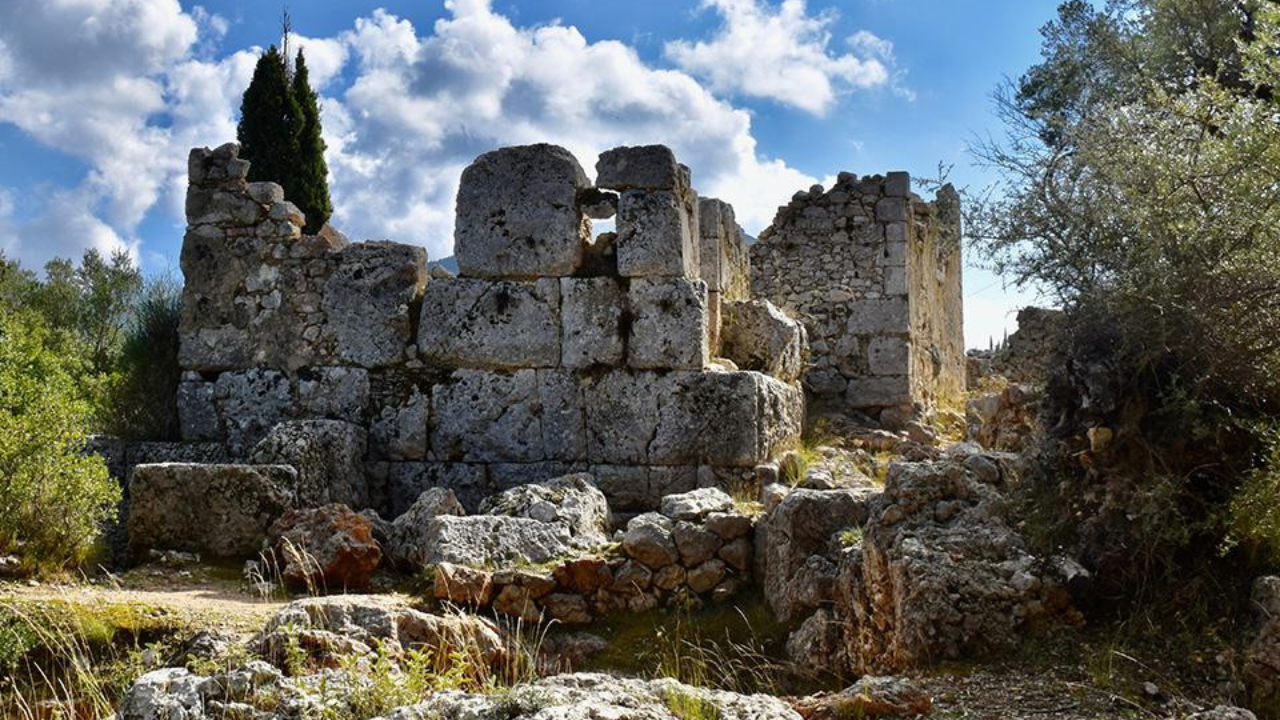
The structure is massive. A two-story complex built with the kind of cyclopean masonry that defines the Mycenaean age—the era of the Trojan War. It features a rock-cut staircase that descends into a past we thought was out of reach. More tellingly, it houses a well that dates precisely to the 8th century BC, the very window when the Homeric epics were being stitched together from oral traditions.
But the real gut-punch isn't the stone. It’s the clay. Among the ruins, researchers found fragments of pottery inscribed with the name "Odysseus."
Imagine a local artisan, centuries after the Trojan War ended, leaning over a wheel. He is etching a name into the wet earth not as a tribute to a fictional character, but as a prayer to a local hero. To a king. This sanctuary wasn't built to honor a myth. It was built to mark a grave, or a palace, or a memory so vivid that the islanders refused to let it die.
The Invisible Stakes of a Name
Why does this matter to us, sitting in a world of glass and silicon?
Because we are obsessed with returning. Every one of us is fighting a private war, trying to navigate our way back to some version of "home" that feels increasingly out of reach. We relate to Odysseus because he is the patron saint of the lost. He spent ten years at war and another ten years wandering the wine-dark sea, losing every man he led, every ship he commanded, and very nearly his own mind.
When he finally reached the shores of Ithaca, he didn't find a parade. He found a house full of vultures—men eating his food, drinking his wine, and trying to steal his wife. He was a stranger in his own kingdom.
For the people of Ithaca three thousand years ago, Odysseus wasn't a metaphor. He was the guy who stayed. He was the proof that you could be broken by the world and still reclaim what was yours. By finding this sanctuary, archaeologists haven't just found old rocks; they have found the physical manifestation of hope.
Consider a hypothetical resident of Ithaca in 800 BC. Let's call him Elpenor. He isn't a warrior. He’s a goat herder with aching knees and a son who wants to run away to the colonies in Sicily. Elpenor climbs the hill to the sanctuary. He brings a small terracotta cup. He leaves it there because he believes that if Odysseus could survive the wrath of Poseidon and the songs of the Sirens to find his way back to this tiny, rocky island, then maybe Elpenor’s son will find his way home, too.
That isn't myth. That is human psychology.
The Geography of Truth
Critics will tell you that the palace doesn't match Homer’s description perfectly. They point to the "Marmati" spring or the layout of the harbor and shake their heads. They want GPS coordinates for a poem written by a blind man who lived hundreds of years after the events occurred.
But look at the site again.
The sanctuary is positioned with a strategic view of the sea, yet it is tucked away, hidden from the immediate gaze of pirates. It is built with a sophistication that matches the palaces at Mycenae and Tiryns. It fits the "Ithaca" of the Bronze Age—a rugged, defiant stronghold.
When we strip away the monsters and the gods, we are left with a very specific historical reality. The Mycenaean world collapsed around 1200 BC. It was a dark age. Trade stopped. Writing vanished. Cities burned. But in small pockets like Ithaca, the memory of the "Great Kings" persisted. They told stories of the men who fought at Troy because those stories were the only things they had left to prove they were once part of something grand.
The discovery of this sanctuary suggests that the Odyssey wasn't just a story about a long trip. It was an oral history of a real dynasty that ruled these islands. It was a map of a family’s survival.
The Weight of the Stone
Walking through the site today is an exercise in humility. You see the massive limestone blocks, weathered by millennia of salt air, and you realize how much effort it took to keep a memory alive. The people who built this sanctuary didn't have heavy machinery. They had levers, ropes, and a desperate need to anchor their identity to a specific patch of ground.
We often think of history as something that happens to other people, in other times. We treat the past like a museum exhibit—static and untouchable. But standing in the ruins at Ithaca, you realize the past is an active force.
The archaeologists didn't find a tomb. They found a heartbeat.
They found evidence that the "hero" we’ve been reading about in high school English classes was a person who walked these specific paths, looked out at this specific blue horizon, and felt the same crushing weight of nostalgia that we feel today.
History is rarely a straight line. It’s a circle. We wander away from the truth, we get lost in the sea of skepticism, and eventually, we find our way back to the shore. The discovery on Ithaca isn't just a win for the history books. It’s a reminder that even after three thousand years of being lost, the truth has a way of coming home.
The stones are there. The name is etched in the clay. The king is no longer a ghost.
The sea still hits the rocks of Ithaca with the same rhythmic persistence it had when Odysseus first stepped onto the sand, wet and exhausted, unsure if anyone would recognize the man he had become.