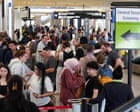
The air in Terminal 3 smells of stale pretzels and anxiety. It is a specific, sharp scent that only exists when three thousand people are compressed into a space designed for five hundred. Somewhere near the front of the serpentine line, a toddler begins to wail. It is not a cry of hunger. It is a cry of collective exhaustion.
We have all been that toddler.
We stand in these lines, clutching our digital boarding passes like talismans, watching the clock tick toward a departure time that feels increasingly like a work of fiction. But while we grumble about taking off our shoes or the sudden shortage of gray plastic bins, the real bottleneck isn't the TSA agent with the tired eyes. The bottleneck is two thousand miles away, in a room filled with mahogany and a mounting pile of rejected budgets.
Washington has hit a wall again. Specifically, the funding for the Department of Homeland Security has stalled, caught in a legislative loop that feels less like governance and more like a glitch in the Matrix.
The Arithmetic of Frustration
Consider Sarah. She is not a real person in the legal sense, but she is real in every way that matters to the economy. She is an independent consultant from Des Moines flying to a career-defining pitch in Seattle. She arrived two hours early. She should be fine.
But the "Should Be" is currently being dismantled by a lack of overtime pay and a hiring freeze.
When a Homeland Security bill fails to pass, the ripple effect isn't immediate like a blackout. It is a slow, agonizing constriction. It means the specialized equipment that scans your bags for microscopic traces of danger doesn't get the software update it needs. It means the "Pre-Check" lane you paid for to save your sanity is staffed by a single person because their colleagues are being shuffled to cover a gap at a different checkpoint.
The numbers are staggering. We are looking at a shortfall that threatens to ground the very fluidity of American movement. The latest legislative collapse marks the third time in eighteen months that the department’s long-term stability has been traded for short-term political leverage. This isn't just about politics. It is about the friction we add to the gears of our lives.
The Cost of the Wait
Every minute Sarah spends shuffled between velvet ropes is a minute of lost productivity. Multiply Sarah by the 2.9 million passengers who fly across the United States every single day.
If the average delay caused by underfunding increases by just fifteen minutes, the American economy hemorrhages millions of dollars in billable hours, missed connections, and canceled meetings. We treat travel as a luxury or a nuisance. We should treat it as the circulatory system of a superpower. When the blood slows down, the body grows cold.
The failure to fund these agencies isn't a victimless stalemate. It is a tax on time.
The irony is that the debate rarely centers on whether the airports need the money. Everyone agrees the machines are aging. Everyone knows the staff is stretched thin. The disagreement is always about something else—a rider on a bill, a border policy, a symbolic gesture meant for a 24-hour news cycle. Meanwhile, the people in Terminal 3 are just trying to get home for a funeral or a wedding or a job interview.
Security is a Quiet Business
When security works, you don't notice it. You walk through a metal detector, grab your laptop, and find a gate. It is a seamless transition from the "outside" world to the "secure" world. This invisibility is a triumph of engineering and human effort.
But that invisibility requires constant, aggressive investment.
Modern threats don't wait for a fiscal year to begin. They evolve with the terrifying speed of a viral clip. To counter them, the DHS needs more than just a "keep the lights on" budget. They need the ability to hire data scientists who can predict crowd swells and engineers who can harden the digital infrastructure against cyber-attacks that could freeze every jet bridge in the country.
When the funding fails, we are essentially asking our defenders to fight a twenty-first-century war with a twentieth-century checkbook.
We often talk about "national security" as a monolith—a wall, a fleet, a drone. We forget that national security is also a tired person in a blue uniform checking an ID at 4:30 AM in Omaha. If that person is worried about whether their next paycheck will clear or if their health benefits are about to be used as a bargaining chip, they are not focused on the bag in front of them.
Distraction is a vulnerability.
The Human Infrastructure
The tragedy of the "failed bill" is that it treats human beings like line items. It ignores the TSA officer who has to explain to their family why they are working for "back pay" that might not arrive for weeks. It ignores the Customs and Border Protection agent who is pulled from a vital screening post to fill a clerical hole created by a budget gap.
This is the hidden cost of the gridlock. It is the erosion of morale.
When you break the spirit of the people who keep the gates, you break the gates themselves. We are seeing a record number of veteran security professionals leave the public sector for private security firms. They aren't leaving because they don't believe in the mission. They are leaving because they are tired of being the collateral damage in a war of words.
They want the dignity of a certain future.
The Choice We Make by Not Choosing
The line in Terminal 3 has stopped moving entirely. A supervisor is talking into a radio, his brow furrowed. There is a "technical issue" with one of the scanners. In a fully funded world, there would be a redundant system or a rapid-response technician on site. In our world, there is a shrug and a growing sense of helplessness.
We have become a nation of waiters.
We wait for the bill to pass. We wait for the line to move. We wait for the leaders to remember that their primary job is to keep the machinery of the state functioning so that we can go about the business of being citizens.
The airport is the great equalizer. In that security line, the CEO and the college student are the same. They are both vulnerable. They are both waiting. They are both subject to the whims of a process that seems to have forgotten they exist.
If we continue to treat the funding of our basic safety as an optional exercise in partisanship, we aren't just risking longer lines. We are risking the fundamental trust that allows a society to move. We are telling every traveler that their time is worthless and their safety is a secondary concern to a talking point.
Sarah finally reaches the front. She is breathless. She has ten minutes before her gate closes. She fumbles with her shoes, her laptop, her dignity. She makes it, barely, collapsing into her seat as the cabin door whistles shut. She is lucky today.
But luck is a terrible way to run a country.
The plane pushes back from the gate. Below, on the tarmac, the lights of the runway stretch out into the darkness—a brilliant, expensive, and fragile path that only stays lit if someone, somewhere, decides it is worth the cost. The engines roar, a testament to what we can achieve when the engineering works.
As the ground falls away, the city becomes a map of glowing veins. It looks perfect from this high up. You can't see the lines from thirty thousand feet. You can only see the connection. It is a beautiful illusion of stability that depends entirely on the exhausted people standing in the stale air below, waiting for a promise that has yet to be kept.
The toddler has finally stopped crying, lulled to sleep by the hum of the terminal, oblivious to the fact that his world is held together by the thin, fraying threads of a budget that doesn't exist.