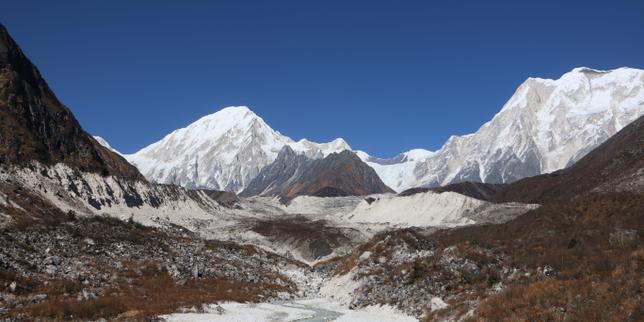
The Himalayas are screaming. If you've ever stood at the base of a 7,000-meter peak, you'll know the silence is actually a roar of shifting ice and falling rock. Scientists call this region the "Third Pole" because it holds more freshwater ice than anywhere on Earth outside the Arctic and Antarctica. But that nickname is becoming a bit of a grim joke. The ice isn't just melting. It's vanishing at a rate that should terrify anyone who drinks water in Asia.
I've looked at the data from the International Centre for Integrated Mountain Development (ICIMOD). It’s brutal. Between 2011 and 2020, Himalayan glaciers disappeared 65% faster than they did in the previous decade. We aren't talking about a slow, geological crawl anymore. This is a collapse. If we don't hit the brakes on emissions, these mountains could lose up to 80% of their ice volume by the end of this century. If you enjoyed this article, you should check out: this related article.
Why does this matter to you if you don't live in a tent in Nepal? Because these glaciers feed ten of the world’s most vital river systems, including the Ganges, the Indus, and the Mekong. Roughly 2 billion people depend on this water for farming, electricity, and literally staying alive. When the "water tower of Asia" runs dry, the geopolitical fallout will make current border disputes look like a playground spat.
The Dirty Truth About Black Carbon
Most people think melting is just about the air getting warmer. That’s only half the story. The real villain in the Himalayas is often "black carbon." It’s basically soot. It comes from wood-burning stoves, old diesel engines, and agricultural fires in the plains of India and China. For another look on this story, refer to the recent update from USA Today.
Wind carries this dark gunk up into the high altitudes. It settles on the pristine white snow. If you've ever worn a black shirt on a sunny day, you know what happens next. The dark surface absorbs solar energy instead of reflecting it. The snow heats up. It melts. This creates a feedback loop that scientists are struggling to map accurately.
The glaciers are getting darker, and as they do, they lose their ability to bounce sunlight back into space. It’s a physical transformation of the landscape. We’re seeing "brown ice" in places that used to be blindingly white. This isn't some future projection. It's happening right now, and it’s accelerating the melt far beyond what simple temperature rise would suggest.
Glacial Lakes are Ticking Time Bombs
As the ice retreats, it doesn't just turn into a nice, steady stream. It pools. It forms massive, unstable lakes held back by nothing but loose rock and debris—what geologists call moraines. These are essentially natural dams made of gravel and prayer.
When these dams break, you get a GLOF. That stands for Glacial Lake Outburst Flood. Imagine millions of tons of water, ice, and boulders screaming down a narrow valley at 60 miles per hour. It wipes out everything. Villages, hydroelectric dams, roads—gone in minutes.
The 2021 disaster in Chamoli, India, was a wake-up call that many people hit the snooze button on. A portion of a glacier broke off, triggered a massive flood, and killed scores of workers at a power plant project. These aren't "natural disasters" in the traditional sense. They are the direct result of a landscape that is literally falling apart because the permafrost holding the mountains together is thawing.
The Myth of Stable Glaciers
You might hear some people point to the Karakoram Range and say, "Look, those glaciers are stable!" This was known as the Karakoram Anomaly. For a while, some glaciers there actually grew or stayed the same size while the rest of the world melted.
Don't let that fool you. Recent studies show the anomaly is fading. The heat is finally catching up. Even the stubborn giants in Northern Pakistan are starting to show signs of thinning. There is no "safe" corner of the Third Pole. The physics of a warming atmosphere are undefeated.
The Human Cost of Vertical Deserts
Up in the high-altitude villages of Ladakh or the Mustang region of Nepal, the crisis is already a daily reality. Farmers who used to rely on predictable meltwater for their barley crops are finding their streams dry when they need them most.
They are becoming "climate refugees" before most Westerners even realize the climate has changed. Entire communities are abandoning ancestral lands because the water simply stopped coming. It’s a quiet, desperate migration.
But there's a flip side. In the short term, some areas actually have too much water. As the glaciers melt faster, river levels rise. It looks like a bounty, but it’s a false one. It’s like spending your life savings all at once instead of living off the interest. Once that "capital"—the ice—is gone, the rivers will shrink to a trickle.
Why Current Infrastructure is a Mistake
Governments in the region are obsessed with building massive hydroelectric dams in these fragile valleys. It’s a high-stakes gamble. They’re building multi-billion dollar concrete structures in the path of potential GLOFs, fed by glaciers that might not exist in forty years.
It’s short-term thinking at its worst. We should be focusing on decentralized water storage and solar power, not betting the farm on Himalayan runoff that is increasingly volatile.
What Actually Works Now
Stop waiting for a global treaty to fix this tomorrow. The people on the ground are already innovating.
In Ladakh, an engineer named Sonam Wangchuk started building "Ice Stupas." Basically, they pipe meltwater into the freezing winter air through a vertical needle. The water freezes into a giant cone of ice—resembling a Buddhist stupa. These artificial glaciers stay frozen much longer than flat snow and provide a steady water source for farmers during the dry spring planting season.
It’s brilliant. It’s low-tech. It’s cheap. This is the kind of adaptation we need. We can't stop the sun from shining, but we can change how we manage the water we still have.
- Support NGOs like ICIMOD that provide real-time tracking of glacial lake levels.
- Push for "black carbon" reduction policies in South Asia, like shifting to cleaner cookstoves.
- Stop investing in large-scale infrastructure projects in high-risk glacial zones.
The Himalayas aren't just a backdrop for trekking photos. They are a life-support system for a third of the planet. If they fail, the ripple effect will touch every economy on Earth. We need to stop treating the Third Pole like a distant problem and start treating it like the burning house it actually is.
Protecting what remains isn't about saving a pretty view. It’s about preventing a regional collapse that nobody is prepared for. Check the source of your electronics and clothes; if they're coming from factories powered by Himalayan-fed coal or hydro, you're part of this cycle. Demand transparency in the supply chains that are heating up the roof of the world.


