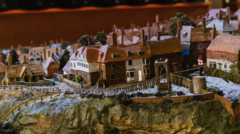
The wind on Tristan da Cunha does not just blow. It interrogates. It pushes against the stone walls of the cottages in Edinburgh of the Seven Seas, searching for a gap, a weakness, a way in. When you are the only doctor for 250 souls marooned in the middle of the South Atlantic, that wind becomes the soundtrack to your own isolation.
I arrived with a trunk full of medical textbooks and a staggering amount of confidence. I left those behind about three days after the last supply ship vanished over the horizon. That ship, the only umbilical cord to the rest of humanity, won't be back for months. There is no airport. There is no "LifeFlight" helicopter coming to whisk a patient away to a specialist in Cape Town. There is only the mountain, the sea, and the weight of every heartbeat on this island resting squarely in my palm.
It was only after the ship left that I realized I had forgotten something fundamental. Not a scalpel or a vial of adrenaline. I had forgotten to pack enough pairs of sturdy trousers. It sounds trivial. It sounds like the punchline to a joke told over a pint in the local pub. But when you are hiking up a volcanic slope in a gale to check on an elderly farmer’s breathing, and the salt spray is eroding the very fabric of your dignity, those missing trousers become a metaphor for the sheer, raw vulnerability of being the only one.
The Mathematics of Solitude
Isolation is a numbers game where the odds are always stacked against the house. In a modern city, the ratio of specialist to patient is a comfort. If your heart stutters, there is a cardiologist. If your skin flares, a dermatologist. Here, the ratio is one to everyone.
I am the pediatrician. I am the geriatrician. I am the dentist when a molar decides to protest in the middle of a winter storm. I am even, on occasion, the vet.
Consider a hypothetical—though entirely plausible—Tuesday. A fisherman crushes his hand in a winch down at the harbor. At the same moment, a child is burning up with a fever that won't break, and the island’s matriarch is feeling a familiar, crushing weight in her chest. In London or New York, these are three different ambulances going to three different wards. Here, they are three knocks on the same door.
You learn to triage with a cold, sharp clarity. You learn that the "golden hour" of emergency medicine is a luxury of the mainland. On Tristan, time stretches. You don't just treat a wound; you manage the weeks of recovery while praying that the limited supply of antibiotics holds out. You become a master of the "what if." What if the generator fails? What if the sea stays too rough for the supply boat to dock next month? What if I'm the one who gets sick?
The Intimacy of the Needle
There is no anonymity in a community this small. In a large hospital, patients are often reduced to bed numbers or symptoms. "The gall bladder in Room 4." On the island, the patient is the man who sold you potatoes yesterday. She is the woman who taught you how to knit the traditional island socks. He is the child who waves to you every morning on your walk to the surgery.
This intimacy changes the way you practice medicine. It makes it heavier. When I hold a stethoscope to a chest, I’m not just listening for a murmur; I’m listening to the history of a family. I know who had the same heart condition twenty years ago. I know who is grieving a loss and whose blood pressure is spiked because of a family feud over a grazing boundary.
The stakes are invisible until they are absolute. There is a specific kind of silence that falls over the island when someone is seriously ill. It’s not just respect; it’s a collective holding of breath. We are a closed system. We are a lifeboat. If one person slips, the whole boat tips just a little bit more into the grey Atlantic.
The Gear We Forget
We talk a lot about "preparedness" in the medical world. We stock up on PPE and digital monitors. We run simulations. But no simulation prepares you for the physical toll of the elements.
The environment here is a character in its own right. It is a jagged, unforgiving protagonist that demands constant negotiation. The lack of trousers wasn't just about cold legs; it was about the realization that my "expert" status was a thin veneer. I had come prepared for the science of medicine, but I was woefully unprepared for the reality of the terrain.
Medicine on the edge of the world is 10% science and 90% improvisation. You learn to use what is at hand. You learn that a patient’s trust is worth more than a state-of-the-art MRI machine. You learn that sometimes, the most effective treatment isn't a pill, but the fact that you showed up, soaking wet and shivering, at three in the morning just to sit by a bedside.
The "competitor" articles will tell you about the logistics. They will list the coordinates of the island (37°S, 12°W) and the population count. They might even mention the trousers as a quirky anecdote. But they miss the marrow of the experience. They miss the feeling of looking out at the ocean at dusk and realizing that the nearest other human being is 1,500 miles away.
That distance does something to your soul. It strips away the noise. It forces a brutal honesty. You can't hide behind a lab coat when everyone knows exactly what you’re afraid of.
The Weight of the "Only"
Being the "only" anything is a burden. Being the only medic is a haunting. You carry the medical records of the entire population in your head. You see a limp across the village square and you’re already calculating the dosage for an anti-inflammatory. You see a cough at the community dance and you’re wondering if a virus has hopped off the last visiting cruise ship.
But there is a grace in it, too.
In the absence of a vast bureaucracy, medicine returns to its most ancient form: a pact between two people. There are no insurance forms to fill out. There are no billing codes. There is only the help needed and the help given. It is a return to a human-centric reality that the modern world has largely traded for efficiency.
I remember a night when the wind was particularly feral. The power had flickered out, and I was sitting in the dark with a kerosene lamp. I looked at my worn-out, salt-stained trousers—the ones I’d been sewing back together because I simply didn't have any others. I realized then that the "stuff" we think matters—the gear, the credentials, the professional distance—is just ballast.
What remains is the connection. The shared vulnerability of living on a rock in the middle of a vast, indifferent sea.
The ship will come eventually. It will bring mail, and fresh fruit, and yes, the crates of clothes I should have brought in the first place. I will put on a new pair of trousers and I will look like a "proper" doctor again. But the man who arrived on that first boat is gone. He was replaced by someone who understands that in the darkest, coldest reaches of the world, we are held together not by our expertise, but by the simple, terrifying fact that we are all we have.
The mountain continues to loom. The sea continues to roar. And tomorrow morning, I will wake up, put on my patched-up clothes, and go see if the island is still breathing.