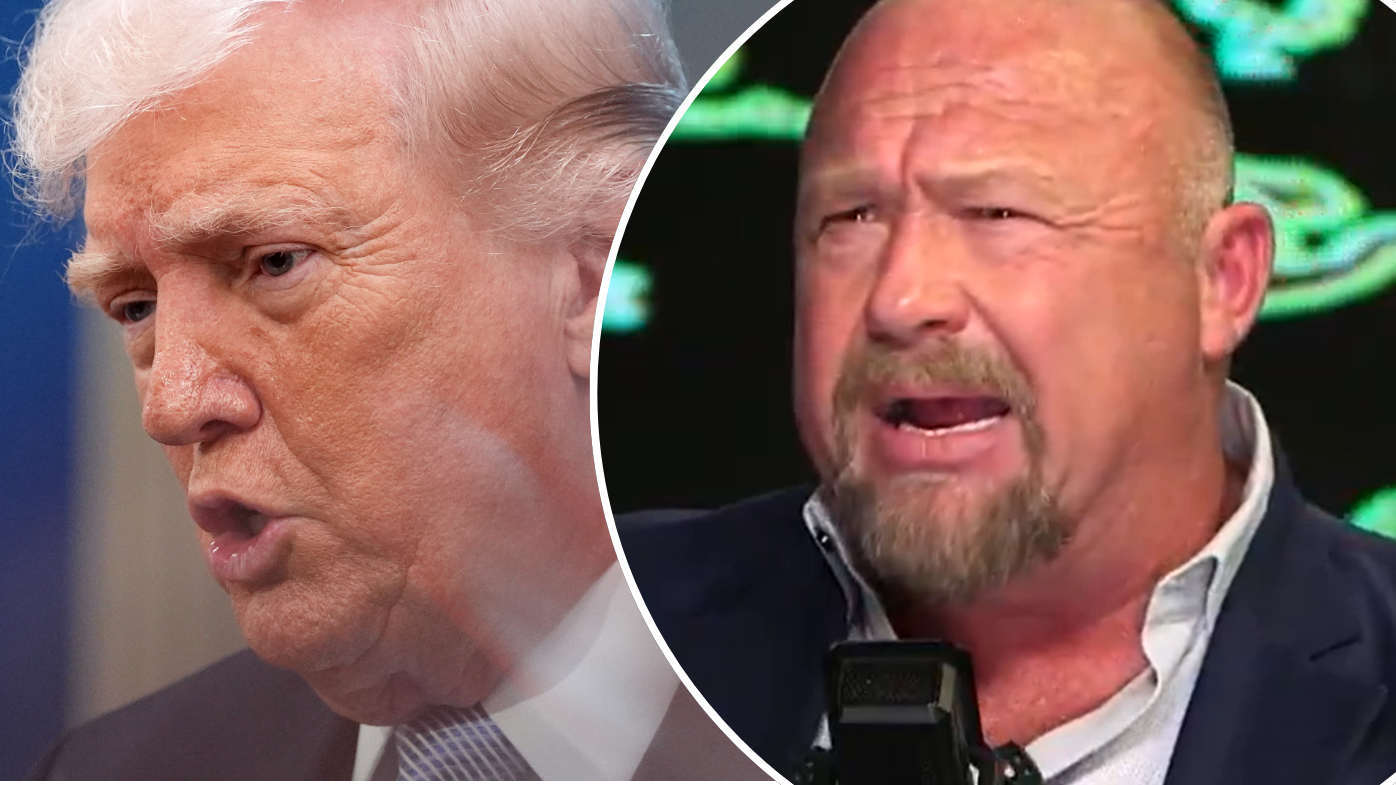
The tension between Donald Trump and high-profile media figures like Tucker Carlson and Megyn Kelly regarding Iran is not a mere personality clash; it is a fundamental friction point between two competing schools of populist foreign policy: Performative Deterrence versus Principled Non-Interventionism. While the former relies on the credible threat of disproportionate force to maintain regional stability, the latter views any Middle Eastern entanglement as an existential drain on domestic resources. The current friction stems from a misalignment in how these factions calculate the risk-adjusted return on military escalation.
The Mechanism of Performative Deterrence
Donald Trump’s approach to Iran operates on a feedback loop of maximum pressure and unpredictable escalation. This strategy, often referred to in international relations as the Madman Theory, seeks to convince adversaries that the costs of defiance are mathematically ruinous. The logic follows a three-stage progression: If you enjoyed this piece, you might want to check out: this related article.
- Signaling Escalation: Utilizing public platforms to broadcast threats that exceed conventional diplomatic protocols.
- Economic Strangulation: The application of secondary sanctions to decouple the target's economy from global credit markets.
- Kinetic Demonstration: Occasional, high-impact military strikes—such as the 2020 Soleimani operation—designed to validate the preceding rhetoric without committing to a full-scale ground invasion.
The "attack" on Carlson and Kelly occurs when these media figures identify a decoupling between the rhetoric and the reality of war. For a populist base, the promise was "No More Endless Wars." When Trump’s rhetoric moves toward a strike on Iran, it triggers a defensive mechanism in the Carlson-Kelly faction, which views such actions as a betrayal of the 2016 isolationist mandate.
The Isolationist Cost Function
Tucker Carlson and Megyn Kelly represent a constituency that applies a strict cost-benefit analysis to foreign intervention. Their opposition to an Iran conflict is rooted in three primary variables: For another look on this development, check out the recent coverage from Al Jazeera.
- The Zero-Sum Resource Drain: Every dollar spent on a carrier strike group in the Persian Gulf is viewed as a dollar subtracted from domestic infrastructure or border security.
- The Refugee Externalities: Learning from the Iraq and Libya interventions, this faction argues that destabilizing the Iranian state would trigger a mass migration event into Europe and potentially the Western Hemisphere.
- The Credibility Gap: A deep-seated skepticism toward intelligence community assessments. This group views "threat intelligence" as a curated product used to manufacture consent for industry-driven military spending.
Structural Divergence in Media Alliances
The criticism from Carlson and Kelly exposes a shift in the conservative media hierarchy. Historically, Republican presidents enjoyed a symbiotic relationship with media outlets that prioritized neoconservative interventionism. However, the current "New Right" operates under a different incentive structure.
The Carlson model thrives on anti-establishment differentiation. By criticizing Trump from the "right" (isolationist) flank, he reinforces his own brand as an independent arbiter of populist truth. This creates a bottleneck for Trump’s communication strategy. If the president cannot maintain the support of his primary media conduits, the perceived cost of an Iranian strike increases domestically, potentially eroding his polling floor among base voters who are war-weary.
The Iranian Escalation Ladder
To understand why this conflict is peaking now, one must examine the specific mechanics of the Iranian escalation ladder. Iran utilizes a "Gray Zone" strategy, employing proxies to strike at Western interests while maintaining plausible deniability.
- Level 1: Proxy Friction: Houthi or Hezbollah activities that disrupt trade or strain regional allies.
- Level 2: Direct Harassment: IRGC naval maneuvers in the Strait of Hormuz.
- Level 3: Threshold Break: Significant enrichment of uranium or direct ballistic strikes on Western assets.
Trump’s recent attacks on his former allies suggest he feels their criticism is narrowing his tactical options. If the media narrative suggests that Trump is "warmongering," it diminishes his ability to use Level 1 and Level 2 threats as a bluff. When a leader's bluff is called by their own supporters, the only remaining options are total retreat or total escalation—both of which carry catastrophic political risks.
The Fallacy of the Surgical Strike
A recurring friction point in these debates is the concept of the "surgical strike." Trump often frames military options as quick, decisive, and low-cost. Analysts within the Carlson-Kelly camp argue this is a fundamental misunderstanding of regional dynamics. The interconnected nature of Middle Eastern geopolitics means a strike on Iranian soil would likely trigger:
- Asymmetric Retaliation: Cyberattacks on Western financial infrastructure or energy grids.
- Energy Market Volatility: A spike in Brent Crude prices that would act as an immediate "tax" on the American consumer, directly undermining Trump’s domestic economic platform.
- Coalition Collapse: Forcing regional partners like Iraq into an untenable position where they must choose between their neighbor and their security guarantor.
Strategic Miscalculation and Public Perception
The disconnect between Trump and his critics also highlights a failure in messaging synchronization. In a data-driven campaign environment, internal polling usually dictates the aggressiveness of a candidate's stance. Trump's willingness to alienate Carlson and Kelly—two of the most influential voices in his orbit—indicates he either believes his base is more hawkish on Iran than the media suggests, or he views the Iranian threat as a genuine "Black Swan" event that supersedes political optics.
The risk of this strategy is the "Demographic Churn." Younger populist voters are significantly more isolationist than the older "Cold War" conservative demographic. By doubling down on the Iran rhetoric, Trump risks alienating the younger cohort that views Middle Eastern intervention as an archaic relic of the previous political era.
The Defensive Realism Framework
From a purely analytical standpoint, the Carlson-Kelly position aligns with Defensive Realism. This theory posits that states should seek an appropriate amount of power to ensure their survival but avoid "over-expansion" that triggers a balancing coalition from other nations. Trump’s counter-critique is rooted in Offensive Realism, suggesting that the only way to ensure US security is to dominate the regional subsystem so completely that no challenge is possible.
These two theories are currently in a state of open warfare within the American Right. The "attack" on these media figures is a symptom of a movement that has yet to decide whether it wants to be an empire or a fortress.
Tactical Recommendations for Navigating the Rift
The immediate path forward for the Trump administration or any similar populist executive requires a recalibration of the "Maximum Pressure" narrative to align with isolationist concerns. This involves:
- Framing Intervention as Asset Protection: Moving the argument away from "regime change" and toward the protection of specific global trade routes that impact domestic inflation.
- The Burden-Shifting Mandate: Explicitly requiring regional allies to provide the bulk of the kinetic force, thereby reducing the "Cost Function" for the American taxpayer.
- Transparency in Intelligence: Overcoming the "Credibility Gap" by declassifying specific evidence of imminent threats, rather than relying on the traditional "Trust Us" model that failed during the 2003 Iraq lead-up.
The survival of the populist coalition depends on resolving this internal contradiction. If the executive continues to prioritize performative strength at the expense of non-interventionist principles, the movement will likely bifurcate, leading to a diminished electoral capacity and a fragmented foreign policy mandate. The current public spat is not the end of the alliance, but it is the first clear evidence of a structural failure in the populist ideological engine.