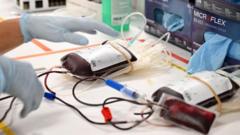
The media loves a "policy shift" story. When news broke that Jehovah’s Witnesses were reportedly "easing" their stance on blood transfusions, the mainstream press tripped over itself to frame it as a religious awakening. They called it a softening of dogma. They painted a picture of a secretive organization finally catching up to modern medicine.
They missed the entire point.
This isn't about a change in scripture. This is about the medical industry finally catching up to a standard of care that the "refusal" community forced into existence decades ago. While surgeons were busy treating whole blood like a magic elixir, the Witnesses were inadvertently funding and demanding the most sophisticated surgical techniques on the planet.
The "lazy consensus" says that refusing blood is a death wish. The reality? Refusing blood created the blueprint for the safest surgical outcomes in history.
The Myth of the Life-Saving Pint
Standard medical practice has long suffered from a "more is better" obsession with hemoglobin levels. For years, the threshold for a transfusion was the "10/30 rule"—if a patient’s hemoglobin fell below $10g/dL$ or their hematocrit below 30%, you hooked up the bag.
It was arbitrary. It was unscientific. It was dangerous.
The truth is that allogeneic blood (blood from another human) is a liquid organ transplant. It comes with a massive inflammatory load, potential for TRALI (Transfusion-Related Acute Lung Injury), and a suppressed immune system that invites post-operative infections. I have watched surgeons use blood as a crutch for sloppy technique for years. If you know you can just "top off" the tank, you don't care as much about the leak.
Jehovah's Witnesses forced the hand of the medical establishment. By removing the "crutch," they forced surgeons to become masters of hemostasis. They pioneered the use of:
- Intraoperative Cell Salvage: Sucking up the patient’s own blood, cleaning it, and putting it back in real-time.
- Acute Normovolemic Hemodilution (ANH): Diluting the blood so that what is lost during surgery has fewer red cells, then re-infusing the concentrated stash later.
- Pharmacological Optimization: Using Erythropoietin (EPO) and IV iron to floor the accelerator on red cell production before the first incision is even made.
The "softening" of rules isn't a retreat; it's a victory lap. The medical world now calls this Patient Blood Management (PBM). It is the gold standard for everyone, not just those with religious objections.
Why Your Doctor is 20 Years Behind
If you walk into a standard hospital today and lose a significant amount of blood, the odds are high that a tired resident will order a transfusion simply because it’s the easiest box to check.
They won't tell you that restrictive transfusion strategies—waiting until hemoglobin hits $7g/dL$ or even $6g/dL$—actually lead to better outcomes in most stable patients. They won't tell you that every unit of blood you receive increases your risk of hospital-acquired infection.
The "ease in rules" being discussed in theological circles regarding "blood fractions" is a semantic distraction. The real story is that the medical community has spent forty years trying to prove the Witnesses wrong, only to find out that the "bloodless" patients often recovered faster and with fewer complications.
I’ve seen cardiac units where the mortality rate for non-blood patients was lower than the general population. Why? Because the surgical team was forced to be perfect. They didn't have the luxury of a "good enough" suture.
The Economic Engine of Refusal
Let’s talk about the money, because that’s where the "religious" narrative falls apart. Blood is expensive. Between recruitment, testing, storage, and the administrative nightmare of tracking units, a single bag can cost a hospital over $1,000.
When a large demographic refuses this product, it creates a market for alternatives. The rise of synthetic volume expanders and advanced coagulation factors didn't happen because Big Pharma felt bad for a small religious group. It happened because the group created a high-value niche for "bloodless" technology.
The "refusal" wasn't a wall; it was a laboratory.
The Danger of the "New" Policy
The danger isn't that the rules are "easing." The danger is that as the stigma of blood refusal fades, the discipline of bloodless medicine might fade with it.
If the pressure is taken off the surgeons to maintain bloodless protocols, they will revert to their old, lazy habits. They will go back to the "10/30 rule" because it’s faster. They will stop using the cell saver because it requires an extra technician.
The contrarian truth: The stricter the religious prohibition, the better the medical care.
When a patient says "No blood, no matter what," the surgical team goes into a state of hyper-focus. They plan. They prep. They execute with a level of precision that "normal" patients never receive. By "easing" the rules or making the stance more nuanced, we risk losing that edge of excellence.
Dismantling the "Public Health Risk" Argument
Critics often argue that these "outdated" beliefs put a strain on the healthcare system.
It’s the opposite.
Blood shortages are a perennial crisis. By developing techniques that eliminate the need for donor blood, these patients are actually preserving the blood supply for the trauma victims who truly have no other choice. They are the ultimate "blood donors" because they don't take any out of the system.
If you want the best surgery of your life, tell your doctor you’re a Jehovah’s Witness.
Even if you aren’t.
Force them to treat your blood like the finite, precious resource it is, rather than a commodity they can buy in bulk from the Red Cross. Force them to use the scalpel like a precision instrument instead of a garden tool.
The Nuance of Fractions
The media gets bogged down in the "fractions" debate—whether albumin, globulins, or clotting factors are "allowed."
This is a theological shell game. For the patient, the only thing that matters is the oxygen-carrying capacity. If you can maintain that without a whole-blood transfusion, you win. The religious nuance of what constitutes "blood" is irrelevant to the physiological reality: human bodies are far more resilient to low hemoglobin than we were taught in the 1990s.
We have seen patients survive with hemoglobin levels as low as $2.0g/dL$ or $3.0g/dL$—levels that would make a first-year med student faint—simply because the delivery of oxygen was managed through high-flow O2 and metabolic slowing.
The Real Status Quo
The status quo isn't a religious group being stubborn. The status quo is a medical-industrial complex that is addicted to the "blood bag" economy.
We are currently in a transition where "Bloodless Centers of Excellence" are popping up in major hospitals like Cleveland Clinic and Penn Medicine. They aren't doing it for God. They are doing it because the data is undeniable: PBM reduces costs, reduces stay lengths, and reduces mortality.
Stop looking at this as a story about a church changing its mind.
Start looking at it as the final validation of a radical medical experiment that worked. The "bloodless" outliers weren't the ones in the wrong—the rest of the medical world was.
The next time you hear about "easing rules," ignore the pulpit. Look at the surgical tray. That’s where the real revolution happened, and it’s a revolution that should have changed your own healthcare years ago.
If you're still relying on a stranger's blood to get you through a routine surgery, you aren't the beneficiary of modern medicine. You're a victim of its inertia.
Demand the "bloodless" standard. Not because of a book, but because of the biology.
Stop asking if they are allowed to take blood. Start asking why you still are.